
Biology
The goal of the Biology Department is to inspire and prepare our students for lifelong learning as professionals in the biological sciences and as scientifically informed citizens, as well as to advance understanding of the natural world through original research.
About the Major
At all levels, biology at Hamilton aims to offer a stimulating, thought-provoking experience, and classes are small. The emphasis on lab work and research gives students ample opportunities to apply what they learn outside the classroom. Many pursue summer research with professors, and all biology majors complete a research project through the Senior Program.
Students Will Learn To:
- Analyze and interpret original and published biological data
- Apply the scientific method in a way that demonstrates comprehension
- Communicate effectively about fundamental biological concepts using scientific language
A Sampling of Courses

Explorations in Biology: The Secret Life of Plants
A thematic course exploring five fundamental features of all biological systems, including structure and function, information flow, energy and matter, interactions, and evolution. Most ecosystems on Earth are shaped by plant life. While it may not seem like it, plants constantly do the same things we do: search for nutrients, secrete hormones, and defend themselves. In this course, we will explore the incredible adaptations plants use to survive and grow, compare these to adaptations of animals, and examine how plants provide the foundation for both ecosystems and human society.
Explore these select courses:
will examine how people are threatening biodiversity across the planet, causing a new mass extinction event. For each threat to biodiversity, we will also discuss conservation and restoration strategies that can be used to protect biodiversity. In lab, we will quantify biodiversity in campus forests, and develop recommendations to guide the college's conservation and restoration efforts.
The relationship between animal behavior and disease is bidirectional: behavior can affect the likelihood of acquiring a disease, and disease can subsequently alter behavior. In this class, we examine the fundamentals of animal behavior (e.g., sexual selection, kin selection, social evolution, communication and signals, reproductive strategies) and apply them to current research on the ecology and evolution of disease. Discussion of foundational readings and the primary literature.
Meet Our Faculty

Mike McCormick
Acting Chair and Professor of Biology, Joel W. Johnson Family Professor of Environmental Science
environmental geomicrobiology, specifically cell/mineral interactions; fate of environmental contaminants; solid-state respiration by bacteria; and molecular microbial ecology

Marine invertebrate biology, particularly the evolution of Mollusca

molecular biology; molecular evolution; genome structures; and bioinformatics

Ecology, freshwater biology, marine biology, microbiology, biogeochemistry, bioinformatics, genomics

gene regulation; patterning and morphogenesis; transcription factors and DNA-binding; regulatory DNA; developmental genetics; molecular biology; embryology; eye development


climate change; invasive species; novel ecosystems; plant-animal interactions; seed predation

evolutionary biology, reproductive physiology, and herpetology

cellular neurobiology and neuroethology; measurement and detection of neurotransmitters; isolation and identification of novel chemical messengers; cellular metabolism in the nervous system

Kyle Martin
Assistant Professor of Instruction Biology, Director of Microscopy
Microscopy, Biomedical Engineering


Genetics, molecular and cellular biology, bioethics, meiotic and mitotic chromosome segregation, spindle dynamics, fluorescence microscopy and live imaging

biochemistry, genetics, and ecology labs; subject matter expert for McGraw Hill Education in physical and biological sciences

conservation biology, agroecology, ornithology, Nearctic-Neotropical migratory birds, and ecotoxicology

behavioral ecology, disease ecology
Faces & Spaces
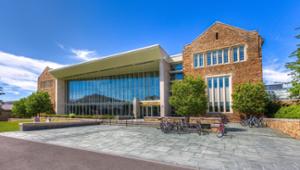
The Taylor Science Center houses the offices for faculty members in biology. The complex contains an atrium with a coffeehouse, an auditorium, a greenhouse, and more than 100 teaching and student research laboratories.



Careers After Hamilton
Hamilton graduates who concentrated in biology are pursuing careers in a variety of fields, including:
- Zoology Professor, Ohio Wesleyan University
- VP Investments, Smith Barney
- Cinematographer/ Microbiologist, Wilderness Film & Video Productions
- Editor, Horticulture Magazine
- Dean for Translational Biomedical Sciences, Mount Sinai School of Medicine
- Orthopedic Surgeon
- Chief, Post Conviction Unit, Philadelphia District Attorneys Office
- Director, Wildlife Conservation Society
- Professor of Clinical Anesthesiology, UCLA
- Senior Policy and Research Analyst, Presidential Commission for the Study of Bioethical Issues
Explore Hamilton Stories

Nannas, Students Replicate Genetic Anomalies
Genetic inheritance might seem straightforward enough. Middle schoolers around the country learn the formulaic predictions of Punnett Squares, and for the most part, the science appears cut-and-dry. Chromosomes passed on through sperm or eggs have a 50-50 shot at inheritance. Right?

Is Brain Fog Limited to Humans?
As Associate Professor of Biology Andrea Townsend was investigating how infectious disease affects the problem-solving performance of American crows, she was surprised to discover how few studies compared the effects of disease on cognition in other species.
Contact
Department Name
Biology Department
Contact Name
Mike McCormick, Acting Chair
Clinton, NY 13323
