
Physics
We aspire to help students forge tools to reveal the stunning quantitative vistas on our universe. Given the various trajectories of Hamilton students, this education prepares students for physics graduate school; supports students in their pursuit of different quantitative interests including engineering, chemical physics, and careers where quantitative analysis is employed; fulfills the one-year introductory physics requirements for students pursuing health professions, chemistry, and graduate work in other sciences; and includes courses accessible to students across the campus with a wide variety of interests and mathematical backgrounds.
About the Major
At Hamilton, physics students learn in small classes with faculty members who offer one-on-one encouragement, personal direction, and research opportunities suited to their needs. Lab work is central to their studies, and senior projects often produce results that are presented at conferences or published in journals. Prospective engineers will be interested in Hamilton’s five-year, combined-degree programs with Columbia University, the Thayer School of Engineering at Dartmouth College, Rensselaer Polytechnic Institute, and Washington University in St. Louis. Astronomy is a minor within the department.
Students Will Learn To:
- Exhibit broad understanding in foundational physics
- Use foundational physics to analyze a diverse set of complex problems
- Demonstrate skills for experimental physics
- Demonstrate skills in technical communication
A Sampling of Courses

Introduction to Astronomy
A description of the universe, starting with the appearance and organization of the solar system and working outward. Development of the heliocentric view. Observational deduction of properties of stars. Stellar evolution and its relation to pulsars and black holes. Galaxies and the structure and history of the universe.
Explore these select courses:
Intensive study of Maxwell’s equations in both differential and integral form; electrostatics and electro-dynamics; special relativity; and the transformation of electromagnetic fields. Introduction to electromagnetic waves and dielectric and magnetic materials.
Meet Our Faculty

Mike McCormick
Joel W. Johnson Family Professor of Environmental Science, Professor of Biology, Chair of Physics
Environmental geomicrobiology, specifically cell/mineral interactions; fate of environmental contaminants; solid-state respiration by bacteria; and molecular microbial ecology

fractal analysis of Jackson Pollock drip paintings; theoretical cosmology; and non-Hermitian quantum mechanics

Experimental condensed matter, electron spin resonance spectroscopy and related electronics, computations and simulations to improve both research and teaching

Experimental condensed matter

Nonperturbative aspects of quantum field theory, theoretical particle physics, lattice gauge theory

neutron spin filters and angular correlations in neutron decay

Exoplanet detection, physics education research, and electronics

quantum gravity, quantum geometry, general relativity and quantum gravity phenomenology

Particle physics, particle phenomenology, supersymmetry, neutrino mixing

computational physics, black holes, and astrophysical plasmas
Particle physics, flavour physics, hadronic physics, future detectors
Faces & Spaces
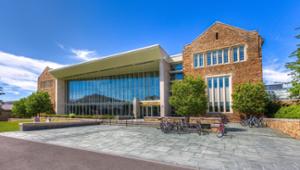
The Taylor Science Center houses the offices for faculty members in physics. The complex contains an atrium with a coffeehouse, an auditorium, and more than 100 teaching and student research laboratories.


Peter’s Observatory


Careers After Hamilton
Hamilton graduates who concentrated in physics are pursuing careers in a variety of fields, including:
- Optical Physicist, NASA Headquarters
- Mechanical Engineer, U.S. Navy
- Professor of Physics, University of Michigan
- Materials Science Engineer, United Technologies Carrier Corp.
- Associate Editor, McGraw-Hill
- Engineer, General Motors
- Senior Scientist, Lawrence Berkeley National Laboratory
- Director, Global Financial Systems, Foster Wheeler Corp.
- Physics Teacher, Natick Public Schools
Explore Hamilton Stories

Physics Students Contribute Research on a Microscopic Level
“This project really taught us that to answer the big questions, sometimes you have to ask a bunch of little questions,” said Sara Cont ’27, who, with Maya Kannan ’25 and Madeleine Petro ’25 embarked on a trailblazing physics project this summer under the guidance of Assistant Professor of Physics Viva Horowitz.
Pearle Publishes Paper Extending an Old Theory
“Relativistic collapse model with quantized time variables,” co-authored by Professor of Physics Emeritus Philip Pearle, was recently published in Physical Review A 112.
Contact
Department Name
Physics Department
Contact Name
Mike McCormick, Chair
Clinton, NY 13323
