
Economics
The goal of the Economics Department is to educate engaged citizens who understand the economic institutions they are part of and who are able to assess and develop opportunities for responsible participation and positive social change.
About the Major
Economics students at Hamilton investigate a wide range of social and economic issues. Students might find themselves exploring the economic legacy of redlining, seeking evidence about the presence and impact of discrimination, evaluating the effects of an increase in the minimum wage, or assessing the effectiveness of policy aimed at improving the environment. In the process, economics concentrators develop strong data analysis skills and learn how to make arguments with quantitative evidence. Some students work with faculty as teaching or research assistants and a few have published collaborative work in professional journals. Economics is a STEM concentration at Hamilton.
Students Will Learn To:
- Design a research plan to address an economic question
- Competently implement a research plan
- Communicate findings from the research plan
A Sampling of Courses

The Economics of Technology and Innovation
An examination of the nature and implications of innovation and technological change. We will investigate the history and economic theory of innovation and technological progress, related policy debates, and future prospects. Particular attention to the implications of recent developments in information technology and robotics for labor markets and the distribution of economic wellbeing.
Explore these select courses:
An introduction to how economists develop and test theory, with a special emphasis on theory explaining the causes and consequences of inequality. The basic concepts of probability and statistics are taught in addition to theories of the labor market, inflation/unemployment tradeoffs, impact of fiscal and monetary policy, externalities, public goods, and international trade.
Examines differences in economic outcomes by race, gender, sexual orientation, religion, or other personal characteristic. Topics include 1) identification of discrimination in different markets including (but not limited to) the labor, education, and credit/housing market, and 2) evaluation of the effectiveness of policies aimed at reducing discrimination. This course places a special emphasis on developing professional presentation and discussion skills, teaching students to discuss controversial topics in a thoughtful and respectful manner.
A study of individual level investment decisions and the equilibrium determination of asset prices. Mean-variance analysis motivated by the tradeoff between risk and return. An introduction to asset pricing models, including the CAPM and multi-factor models. An introduction to derivatives, including stock options, futures and swaps. Discussions of the Efficient Markets Hypothesis, arbitrage, and contributions from behavioral finance. Other topics may include: fixed income pricing, Arrow-Debreu securities and the completeness of markets, and the binomial asset pricing model.
Meet Our Faculty

international economic development and labor economics

Industrial organization, health economics, economics of non-profits, applied econometrics

Macroeconomics, monetary economics, macro-finance

Environmental, energy, and behavioral economics; applied econometrics

Economic history, political economy, law and economics

macroeconomics

economics of poverty, immigration and immigrant policy

International trade and development economics

Ann Owen
Professor of Economics and the Henry Platt Bristol Professor of Public Policy
Macroeconomics, growth, monetary policy, inequality

Macroeconomics, monetary and fiscal policy, and international economics

profit sharing and flexible workplace practices and their effects on firm performance; prior information and biased estimation methods

Macroeconomics, environmental economics

Labor economics, behavioral economics

Economics of education, marriage/family economics, and labor economics

Labor economics, economic history

Economics of education, labor economics, experimental economics

health and health care, higher education, economics of happiness

behavioral and experimental economics



Careers After Hamilton
Hamilton graduates who concentrated in economics are pursuing careers in a variety of fields, including:
- Senior Vice President, Morgan Stanley Dean Witter Reynolds
- Physician, Orlando Heart Center
- Assistant Professor of Economics, Williams College
- 1st Lt., U.S. Marine Corps
- English Teaching Assistant, U.S. Fulbright Program
- Vice Chairman, General Electric
- Director of International Programs, Michigan State University
- Associate Director, CBS News
- Psychiatrist, Buffalo Veteran’s Hospital
- Senior Policy Analyst, Council of State Governments Justice Center
- Director, Deutsche Bank Securities
Explore Hamilton Stories

Students Explore Career Interests in Internships Around the World
Hamilton students explored career interests around the world this summer. Read about a few of them here.
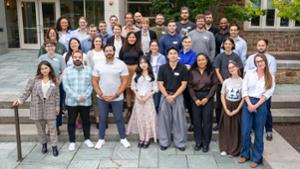
Hamilton Welcomes New Faculty for 2026-27
Hamilton welcomes 40 new faculty members for the 2026-27 academic year, including six tenure-track professors in Economics, French and Francophone Studies, Government, German/Russian/Italian/Arabic, History, and Mathematics and Statistics.
Contact
Department Name
Economics Department
Contact Name
Emily Conover, Chair
Clinton, NY 13323
