
Mathematics and Statistics
The goal of the Mathematics and Statistics Department is to enable students to analyze and organize information using quantitative and statistical tools, to reason and argue logically, to employ appropriate problem-solving strategies, and to communicate complex ideas clearly and efficiently.
About the Major
Ancient thinkers recognized mathematics as the language of the natural world. Today we know it drives science and social science, business and industry, even art and design. Math majors at Hamilton explore both the abstract, theoretical aspects of mathematics and its applications to a variety of topics. The curriculum delves into the many branches of math, and courses foster deductive reasoning, persuasive writing, and analytical and quantitative problem-solving. Those who love math will find themselves among like-minded peers and mentors, talking shop outside their professors' offices and producing research that they may present at a professional conference. The department also offers a minor in statistics.
Students Will Learn To:
- Use mathematical and/or statistical tools to model real-world problems
- Construct mathematical proofs based on rules of logical inference
- Communicate complete mathematical and/or statistical arguments
A Sampling of Courses

Graph Theory
An introduction to the theory and applications of graph theory. Topics include: trees; connectivity; Eulerian and Hamiltonian graphs; vertex-, edge- and map-colorings; digraphs; tournaments; matching theory; planarity and Ramsey numbers.
Explore these select courses:
This course covers statistical methods in machine learning such as decision trees, random forests and support vector machines The course will use a project-based approach to give students hands-on experience using these techniques by analyzing large and complex real-world datasets. More importantly, they will learn the statistical principles behind these procedures, such as loss functions, maximum likelihood estimation and bias-variance trade-off as well as why these principles matter in real world settings.
Number theory is the study of the properties of the positive integers. Topics include divisibility, congruences, quadratic reciprocity, numerical functions, Diophantine equations, continued fractions, distribution of primes. Applications will include cryptography, the practice of encrypting and decrypting messages, and cryptanalysis, the practice of developing secure encryption and decryption protocols and probing them for possible flaws. Speaking Intensive.
Meet Our Faculty

Michelle LeMasurier
Samuel F. Pratt Professor and Chair of Mathematics & Statistics
dynamical systems and topological dynamics

noncommutative algebras, Lie (super)algebras, quantum (super) groups, and representation theory

Uncertainty quantification, probabilistic modeling and simulation, mathematical biology, and high-performance computing

low dimensional topology; knot theory; Heegaard Floer homology; differential geometry; contact geometry

Dynamical systems, symbolic dynamics, and ergodic theory

Commutative algebra, homological algebra, and applied algebra

Combinatorics, graph theory

analysis and commutative Banach algebras

nonparametric density estimation and quantile regression models

Dynamical systems, operator algebras, K-Theory

Mathematical optimization, machine learning, signal and image processing

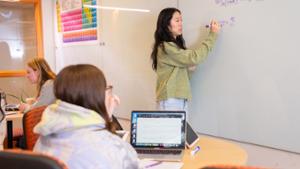
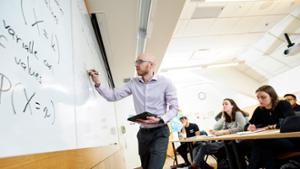
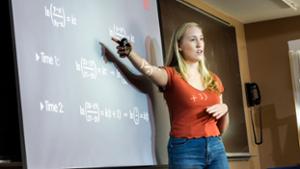
Faces & Spaces


Careers After Hamilton
Hamilton graduates who majored in mathematics are pursuing careers in a variety of fields, including:
- Financial Analyst, The New York Times
- Resident Physician, Westchester Medical Center
- Business Analyst, Federal Reserve Bank of New York
- Professor of Industrial Engineering, Northeastern University
- Software Engineer, Mitre Corp.
- Legal Analyst, Department of Justice
- Actuarial Analyst, GEICO
- Math Teacher, Midlakes High School
- Infectious Disease Epidemiologist, UNC Gillings School of Global Public Health
Explore Hamilton Stories
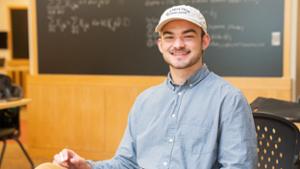
Williams ’26 Designs Efficient Delivery Routes for Food Bank of CNY
With 26 locations needing a different number of food pallets each day — and 10 trucks each with their own capacity limits — designing an efficient route had been an arduous task for the Food Bank of Central New York (FBCNY). That’s where Hughes “Hugh” Williams ’26 came in. This summer he created an algorithm that can determine each day’s optimal route within seconds.
Hamilton Welcomes New Faculty for 2026-27
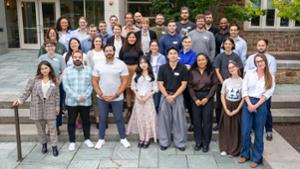
Hamilton welcomes 40 new faculty members for the 2026-27 academic year, including six tenure-track professors in Economics, French and Francophone Studies, Government, German/Russian/Italian/Arabic, History, and Mathematics and Statistics.
Contact
Department Name
Mathematics and Statistics Department
Contact Name
Michelle LeMasurier, Chair
Clinton, NY 13323
