
Philosophy
The goal of the Philosophy Department is to work with students to develop the skills of critical analysis, powerful speaking, and clear writing, skills alumni find of singular practical use in a wide variety of careers, and indispensable to their work as responsible citizens. We emphasize the value of philosophical examination for understanding broad issues that concern us all.
About the Major
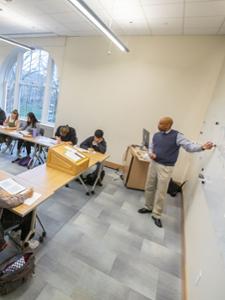
At Hamilton, philosophy professors encourage students to engage actively in classes. Our small introductory classes focus on primary sources rather than predigested material in textbooks. All courses invite students to participate in collaborative conversations, with emphases on developing clear writing and presentation skills. Philosophy majors apply their training beyond the classroom through experiential learning projects or by participating in our exciting summer program. Visiting speakers bring some of the most prominent names in philosophy to campus and into our classrooms.
Students Will Learn To:
- Explain a range of philosophical views, historical and contemporary
- Identify philosophical problems in philosophy, other academic disciplines, or outside the academy
- Formulate their own views about philosophical problems in conversation with other philosophical works
- Defend those views cogently in writing and in speech
A Sampling of Courses

Environmental Ethics
Examines the appropriate relation of humans to the environment. Specific topics include ways of conceptualizing nature; the ethical and social sources of the environmental crisis; our moral duties to non-human organisms; and the ethical dimensions of the human population explosion. The goal is to help students arrive at their own reasoned views on these subjects and to think about the consequences of everyday actions, both personal and political. Preference given to environmental studies majors and minors, starting with seniors.
Explore these select courses:
Meet Our Faculty

Russell Marcus
Christian A. Johnson Excellence in Teaching Professor and Acting Chair of Philosophy
philosophy of mathematics, logic, modern philosophy, and pedagogy

Dallas Amico-Korby
Truax Postdoctoral Fellow and Visiting Assistant Professor of Philosophy
Social epistemology, philosophy of technology

Ethics, ancient philosophy, social and political philosophy

Truth, metaphysics, Eastern philosophy, philosophy of language, ethics, epistemology, philosophy of sport, history of philosophy

A. Todd Franklin
Eugene M. Tobin Distinguished Professor of Philosophy and Africana Studies
existentialism, African-American philosophy, and Nietzsche

Marianne Janack
John Stewart Kennedy Professor of Philosophy, Acting Program Director of Jurisprudence, Law and Justice Studies
epistemology; philosophy of science; philosophy of mind; theories of identity; feminist theory; philosophy and literature; American pragmatism

Epistemology, ethics, aesthetics

moral psychology, metaethics, and social epistemology
Faces & Spaces



Careers After Hamilton
Hamilton graduates who concentrated in philosophy are pursuing careers in a variety of fields, including:
- Writer, Simon & Schuster
- Psychiatrist, SW Connecticut Mental Health
- Director & Counsel, Credit Suisse Securities
- U.S. Ambassador, Federal Republic of Germany
- Professor of Psychiatry, Case Western Reserve University
- Assistant Professor of Philosophy, Virginia Tech
- Senior Scientist, GE Global Research
- Director, U.S. Department of Transportation
- Vice President, Goldman Sachs
- Officer, U.S. Marine Corps
- Principal Law Clerk, New York State Supreme Court
- Lieutenant, U.S. Public Health Service, Centers for Disease Control and Prevention
Explore Hamilton Stories

Three Class of ’25 Grads Receive Fulbright ETAs
Three jet-setting members of the class of ’25 are packing their bags and heading to new countries through the prestigious Fulbright English Teaching Assistantship (ETA) awards. They will return to study abroad favorites, embrace new cultures, and serve as bridges between the U.S. and the world. In addition, Jason Le ’23 is the recipient of an ETA Award to Vietnam.

Marcus and Scheichet ’25 Publish Essay on Syllabus Diversification
A co-written essay by Professor of Philosophy Russell Marcus and Ashley Scheichet ’25, "A Contemporary Connections Option for Early Modern Syllabus Diversification," was recently published in Teaching Philosophy, the premiere journal for the scholarship of teaching and learning in philosophy.
Contact
Department Name
Philosophy Department
Contact Name
Russell Marcus, Acting Chair
Clinton, NY 13323
