
Geoarchaeology
The goal of the Geoarchaeology Program is to encourage connections between geological concepts and methods to aid in the interpretation of the archaeological record of past societies.
About the Major
Geoarchaeology is the study of techniques and methods used to understand geological processes applied to the archaeological record and how humans engage, utilize, and move through landscapes during the past. Students combine a sequence of courses in archaeology and geosciences for broad study of theory, method, and analysis in both disciplines. Topics of focus include geochemistry, stratigraphic succession, paleoenvironmental reconstruction, and landscape evolution. Opportunities for research include fieldwork in eastern Africa, Romania, the Pacific Northwest, eastern North America, and Central New York.
Students Will Learn To:
- Engage with disciplinary fundamentals from anthropological archaeology
- Engage with disciplinary fundamentals from geosciences
- Combine practice and methodology through research design
- Apply disciplinary perspective(s) in an original research project
A Sampling of Courses

Analytic Methods in Archaeology
A survey of analytic techniques central to archaeological and paleoecological interpretation. Laboratory performance of artifact analysis and classification, computer-aided data management and statistical analysis. Three hours of class and three hours of laboratory.
Explore these select courses:
This course focused on how the fundamentals of sedimentology and stratigraphy can be used to reconstruct past environments and study how they change through time. This will include a study of the classification of siliciclastic and carbonate rocks, how the energy of systems controls the type of rocks deposited, and the paleoclimatic/tectonic significance of depositional sequences. Three hours of class and three hours of laboratory with field trips.
A field study of the geology of southern and central Arizona. Emphasis will be placed on examining evidence of large-scale geologic processes and how humans interact with, are influenced by, and modify the natural environment. A 10-day, intensive field course emphasizing experiential learning. Course will involve moderate hiking in remote areas.
Meet Our Faculty

Catherine Beck
Chair and Associate Professor of Geosciences, Co-Director of Geoarchaeology
Sedimentology, stratigraphy, paleolimnology, paleoenvironmental reconstruction

Nathan Goodale
William R. Kenan Jr. Professor of Anthropology, Associate Provost, Co-Director of Geoarchaeology, Chair of Art History
complex hunter-gatherers in the interior Pacific Northwest; the forager/farmer transition in Southwest Asia; rural coastal adaptations in western Ireland
Faces & Spaces
The Taylor Science Center complex contains an atrium with a coffeehouse, an auditorium, a greenhouse, and more than 100 teaching and student research laboratories.


Explore Hamilton Stories

Two Geosci. Majors. Two Passion Projects. Two Watson Fellowships
Andrew Fredericks ’25 and Charlie Haberstock ’25 both received a 2025 Thomas J. Watson Fellowship, a national $40,000 grant to pursue a one-year passion project anywhere in the world. While receiving the award is a feat in and of itself, the two geosciences majors were particularly excited when they heard that the other had won.
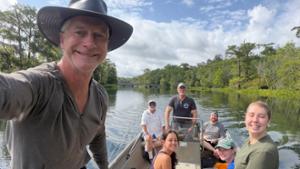
Hamilton Students Dive Into 20,000 Years of Florida River History
On Florida’s Wakulla and St. Marks rivers, a group of Hamilton researchers spent their summer snorkeling for freshwater snails, watching for alligators and manatees, and collecting samples that preserve thousands of years of environmental history.
Contact
Department Name
Geoarchaeology Program
Contact Name
Cat Beck and Nathan Goodale, Program Co-Directors
Clinton, NY 13323
