
Music
The goal of the Music Department is to enable a broad range of students to explore a wide variety of musical experiences and practices. Supported by their development of musicianship and technical skills, concentrators will acquire a more sophisticated understanding of music in historical and cultural contexts, theory and composition, and performance, while pursuing one of these areas in greater depth.
About the Major
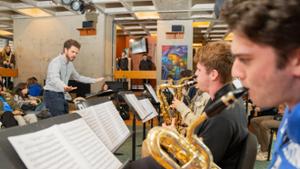
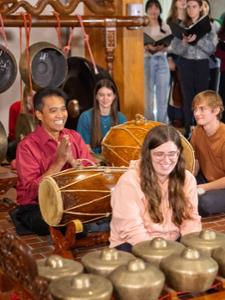
Hamilton’s music concentration is very flexible and the music community vibrant, with abundant opportunities for students to create and perform. In addition to courses in music theory and history, private lessons, and various ensembles, the curriculum includes courses in world music, music and film, folk and country music, opera, the history of jazz, jazz arranging, composition, conducting, and music technology. Students can explore the state-of-the-art digital music studio, play in our Javanese gamelan, or hear legendary musicians share their experiences in our Fillius Jazz Archive.
Detailed information on ensembles, lessons, and facilities can be found on the Department-maintained site.
Students Will Learn To:
- Demonstrate active listening skills from among a wide variety of musical experiences and practices
- Make links between various musical styles and their historical and cultural contexts
- Demonstrate proficiency in various theories of music
- Display skills in making music through performance, composition, recording, or production
A Sampling of Courses

Conducting
An introduction to the craft of conducting, including gestural technique, score reading and analysis, and rehearsal technique (both instrumental and choral). Focus on developing a clear, expressive and communicative technique, and on a conductor’s process of learning a score. Text readings from Elizabeth Green, Markand Thakar, and Sam Adler on technique and the orchestral instruments, analysis assignments of orchestral excerpts conducted with piano, and reflections on different bodies and identities conducting (such as Natalie Stutzmann, Kwamé Ryan, Xian Zhang, Maria Schneider) culminate in leading a full orchestra.
Explore these select courses:
This course explores the nature of silence in literature and music as a way to understand how sound, or lack thereof, came to shape modern Europe. We will discuss the history of silence as a philosophical concept, as a response to crisis, alienation and negation, gendered muteness, as well as the aesthetics of dissonance. Literary and musical selections include Boethius, Dante, Petrarch, Gaspara Stampa, Hugo von Hofmannsthal, Robert Musil, Arnold Schoenberg, Theodor Adorno, Eugenio Montale, Anna Banti, Alda Merini, Luigi Nono, Ingeborg Bachmann, George Steiner.
Intensive study of music theory topics, analytical techniques, and compositional approaches applied to common musical forms and styles from different traditions, including Western classical music, popular, jazz, film, theater, and selected world music. Selected repertoire will emphasize 20th- and 21st-century practices.
Meet Our Faculty

acoustic and electro-acoustic composition; post-tonal analysis; audio programming; algorithmic composition; mobile platform development of audio applications

Musical theater, popular music, Latin American music, 20th- and 21st-century music, and popular-classical crossovers

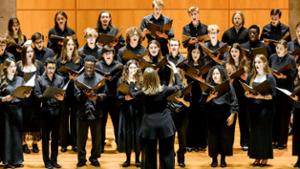
Choral repertoire and conducting; phonetic transcription of Afrikaans choral music; group vocal technique; choregie and interdisciplinary ensemble performance; text-painting in a cappella music; children’s choir composition; equity, diversity and inclusion in the choral literature canon

Heather Buchman
John L. Baldwin, Jr. Professor in Music, Chair of Dance and Movement Studies
orchestral repertoire and conducting; ballet and opera conducting; trombone and low brass; solo performance; 20th- and 21st-century music

Jazz, composition, jazz pedagogy, jazz pedagogy in European Sinti communities

Dolly Parton; American folk and traditional musics; banjo, music and film; medieval and renaissance music; music and gender
Jazz percussion

jazz guitar

violoncello

keyboard and organ; keyboard harmony

Vocal performance

Flute


Harp

Percussion

Folk guitar

Vocal performance


Voice

Bass

Bassoon

clarinet

oboe

Classical guitar, fingerstyle guitar, solo and chamber music performance, guitar pedagogy, 20th-21st century music

jazz piano

Piano

Voice

trumpet

Monk Rowe
Joe Williams Director of the Fillius Jazz Archive and Lecturer in Music (Saxophone)
Jazz history, Saxophone ensemble

Piano performance

piano


Violin and viola

Vocal instruction

Voice
Faces & Spaces


Careers After Hamilton
Hamilton graduates who concentrated in music are pursuing careers in a variety of fields, including:
- Sound Design, WHYY-FM, Philadelphia
- Director of Finance, American Composers Forum
- Professor of Music and Music Technology, California State University San Marcos
- Conductor/Artistic Director, Indianapolis Opera
- Pediatric Dentist
- Violinist, American Ballet Theatre
- Senior Manager Digital Products, Los Angeles Times
- Executive Director, New Hampshire Humanities Council
- Assistant Professor of Music-Voice, Crane School of Music
- Senior Vice President, Bank of America
Explore Hamilton Stories

Alex Kim ’25, a music and math double-major, spent his summer exploring machine learning and music through the help of an Emerson grant. With the guidance of Assistant Professor of Music Charlotte Botha, Kim developed a vocal register classification tool through machine learning models.

Hamilton Professor Shares Dolly Parton Expertise with National Press
In the days following the passing of country music legend Dolly Parton on Aug. 25, media outlets reached out to the Hamilton College John and Anne Fischer Professor of Fine Arts in Music, Lydia Hamessley, for her expertise as an author of two books about the singer and her songs.
Contact
Department Name
Music Department
Contact Name
Ryan Carter, Chair
Clinton, NY 13323
