Janelle Bonagurio
October 28, 2026
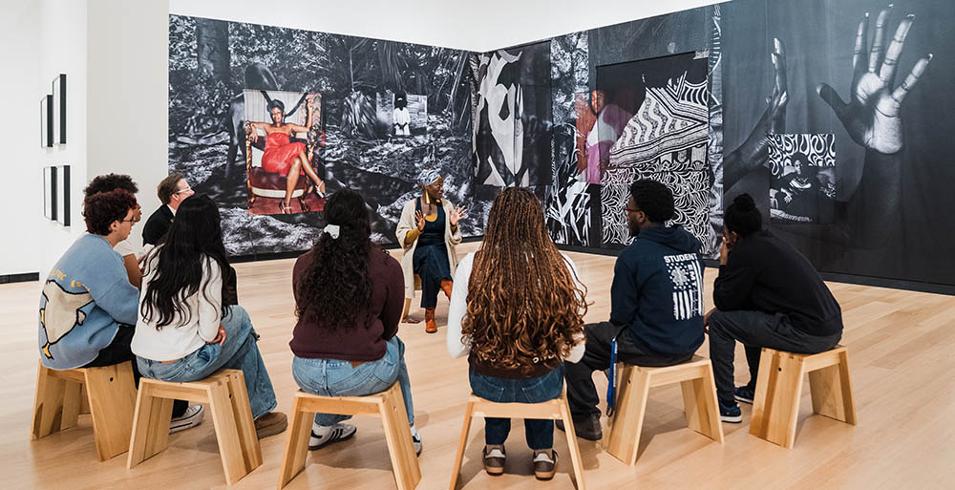
During a picturesque week in late October, I was fortunate enough to host artist Keisha Scarville on Hamilton’s campus for programming held in conjunction with the exhibition Storytelling: Photographers Making Meaning | Works from the Wellin Collection, where her brand-new installation titled Look/Back/Here can be seen. Over the course of three days, Scarville chatted with students, faculty, and staff about myriad issues pertaining to her practice, including topics of power dynamics, visibility, history, trauma, and narrative. But the issue that continued to surface in these conversations, whether large or small, brief or extended, was the concept of perspective, in all of its literal and metaphorical capacities. I thought this paradigm was particularly fitting given that Scarville’s installation combines different materials and photographic formats, so that what a viewer sees and the connections they can make will change based upon how they move through the space.
So we thought perhaps the idea of “perspective” could even be the guiding principle behind this blog entry, which is to say, the idea was suggested that I could include some other perspectives on Scarville’s visit to campus beyond my own. And with that, I asked three of our Hamilton students to offer their own reflections on what it meant to have time to speak with a professional artist. First, I asked students Nana Hayrumyan and Luka Kelava to reflect on Scarville’s visit to their respective studios for one-on-one critique sessions.
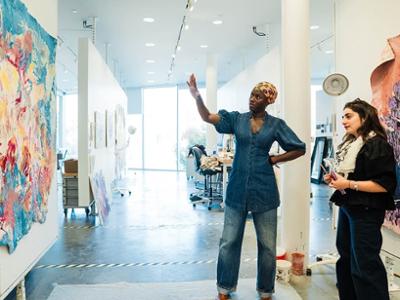 |
An artist-to-artist conversation offers a unique opportunity to question your own impulses, to see your work through another maker’s eyes, and to explore possibilities in your creation that emerge through these “critiques,” which are, at their core, conversations. Keisha Scarville's senior studio visit was an invitation to look at my work anew, to notice formalist and conceptual elements Keisha was particularly drawn to, and to consider art historical narratives without losing sight of the intuitions that initially brought the work into being. The Wellin Museum and the Art Department's cross-disciplinary exchanges are an invaluable gift to us as Art students, and Keisha's visit only reinforced the importance of artistic dialogues in every kind of creation.
-Nana Hayrumyan, Class of 2027
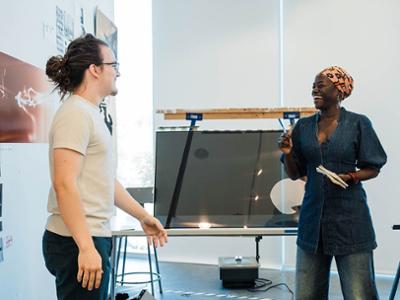 |
In a room with symptoms of my art on its walls, Scarville grounded our conversation in questions of where a viewer might enter that process. If, through my art, I am remembering something myself, where might someone else's prior experiences live within it? It's a fair question. I came to our meeting with a lot to talk about and left with more to think about. Even writing this reflection became another return to the experience, another opportunity to consider what it holds. Scarville got to the root of questions that had made my own expression difficult to understand, remarkably quickly. With those questions distilled, I’ll relay her words of encouragement to “do something simply because you wanted to do it."
-Luka Kelava, Class of 2027
Lastly, I asked senior Brennan Cunningham to share a bit about his experience interviewing Scarville for the Wellin Museum’s docent magazine Collection:
I had the opportunity to sit down with Keisha Scarville for the Collection Magazine. I previously had been acquainted with her during her pre-exhibition talk with docents in August. After hearing about her exploration of an archive belonging to her partner’s deceased father (Luther Williams Jr. Esq.), I was compelled to share my own recent experience of going through my father’s photography collection after his death. Months later, when I sat down to conduct the interview, I was struck that she remembered me and our conversation. Her care for detail and attentiveness carried throughout our interview. I specifically appreciated her answer for what makes a good portrait, responding with a concept from Dawoud Bey: “How do I get into the interiority of the person, like, and how do I get that to come through in the image? And so, what I love about that is that [Luther Williams Jr. Esq.] doesn't foreground his talent like he foregrounds the person and foregrounds wanting their sense of who they are, a sense of their humanity to come through.”
I’m fascinated with this answer, specifically exploring the interiority of the women displayed in the exhibit has given me so much more to unravel. I was slightly nervous going into the interview, but Keisha’s humor and consideration quickly put that at ease. One moment that stood out was when she briefly began interviewing me! As a government major, I ended the interview by asking about how refusal, a concept she explores, is becoming harder with AI and data collection. This concept ties into her ‘Passports’ project, and the idea of refusal in the confines of state documentation. “Technology continues to be developed, and there is this way in which the government or state appropriates that for purposes of surveillance… Are there spaces to refuse anymore, and is it possible?” It was an amazing opportunity to get to talk to Keisha Scarville, and I certainly will be thinking about what we discussed for a long time.
-Brennan Cunningham, Class of 2028
These thoughtful reflections remind me that when we talk about “bringing the world to Hamilton” it’s not a passive experience for our community. It’s about more than just bringing world-class art to our galleries for people to view, it’s about how our students engage with the artwork, how they can gain insight and knowledge from speaking directly with our artists. It’s about how the sharing of multiple perspectives helps shape our understanding of our society and each other.


Grant Supports Object-Based Study for K-12 Students
More Blog