Stepping into the Syllabus: A Veteran Alpinist Sees the Himalaya Through the Eyes of College Students
Maurice Isserman, the Publius Virgilius Rogers Professor of American History and author of Continental Divide: A History of American Mountaineering, is featured prominently in Pete Takeda’s Alpinist article “Stepping into the Syllabus: A Veteran Alpinist Sees the Himalaya Through the Eyes of College Students” (Issue 94, Summer 2026), about Isserman’s course History and Literature of Himalayan Mountaineering, from the Nineteenth Century to the Present.

Full text published with permission from the Alpinist. Words and photos by Pete Takeda.
In midmorning of Day 4 we cut across the slope, silently following the contour of the mountain as it curves up, around and then over a wide swell of snow. This avalanche debris must be weeks old judging by its ropy lavalike flow. The white surface is dense, uniform and pocked with windblown dust motes, the tiny grains of rock lending a greyish pallor. The footing is slick and uneven. As one often does while climbing in this range, we tread carefully in the steps of the person in front.
Past a notch in the skyline, the snow extends into a broad gully that narrows after gaining several hundred meters to its point of origin. The open bowl screams danger, ringed as it is by a horseshoe of steep granite that collects wind-driven snow at the 5000-meter mark. Above that, the mountain rises, a sharp rib soaring into the mist for another 1500 meters. The summit is obscured by a thick grey mass of clouds. Only in the Greater Ranges does one find such vast scale—and terrain so expansive that it defies conventional measure.
I’m walking with veteran trip leader Andrew Jillings and a handful of Sherpa, Gurung and Tamang guides. I’m not sure if the college students we are ushering through here can imagine the torrential violence that deposited these millions of tons of debris. Having survived more than one avalanche in this range, I can close my eyes, hear the roar in my head and feel the rumble in my chest. The snow is a mute reminder that while this is a popular trek, we are in the Himalaya.
I was around for the birth of sport climbing, those first indoor comps, the explosion of modern mixed climbing and all that. I was an early adopter of cams, sticky rubber, cordless power drills, U-stemmed TCUs, LED headlamps and crash pads. I met my heroes—Yosemite Golden Agers, Stonemasters, the leading lights of various genres. I met Honnold when he was an obscure yet talented young climber. I got to climb with most of them. I learned that part of knowing them was to repeat their best first ascents. It was to glimpse their legacy, something recorded in the rock or ice.
I watched climbing go from a marginalized lifestyle to what it is today. I read the books and wrote a few. I studied how-to manuals, guidebooks, memoirs, fiction and histories. At a bare minimum I wanted to know who came first on a particular route or if that new line I spotted had already been done.
Climbing history has recently become an object of study as a rigorous course in the halls of a top-tier college in upstate New York. When I consider this, I feel that climbing has come of age in a manner that validates our passion.
Sixteen college students, two staff, a half dozen local guides and I are on the annual Hamilton College Annapurna field trip. This trip is the experiential learning component of an upper-division course created and taught by Dr. Maurice Isserman.
The course code is HIST 367, and the official title is the History and Literature of Himalayan Mountaineering, from the Nineteenth Century to the Present. For climbers, when HIST 367 first appeared as a college class offering, it marked an arrival. Our sport has reached an inflection point, following a pattern in which an activity first develops literature, then a history, and then the reflection of practitioners. Finally, a university formalizes those into a curriculum.
As of summer 2026, HIST 367 has run for nine years. Though the trek component fell prey to Covid restrictions for two of those years, when it has happened, it provides substance beyond what’s found in the confines of a classroom. Anne McGarvey, of the 2017 class, was part of the first cohort to make the trip. She wrote in the Hamilton blog that “the act of studying … paired with the experience of going to the Himalaya exponentially reinforces and invigorates the knowledge obtained in the classroom.” She added that it “offered an incredible interdisciplinary dive … I otherwise would have never gotten on my own.”
I get the feeling that this course is legendary among incoming and outgoing students. When registration opens, the spots fill instantly, so luck plays a role for getting in. Part of the allure must be the physical challenge of the trek. If the weather and conditions permit, the journey takes students into the mountains, on to Annapurna Base Camp and then back west on a few scenic segments of the Annapurna Circuit. The thirteen-day itinerary fits Hamilton’s two-week spring break, and the trail delivers a manageable, if strenuous, ascent to a maximum altitude of 4130 meters (about 13,550'). Isserman tried other options but Annapurna won out, if only by logistics alone.
Annapurna is steeped in climbing lore: it was the first 8000-meter peak to be climbed; the first to be climbed by an all-woman team (with male Sherpa support); and the site of the first Himalayan super-alpine climb on its massive south face. Repeatedly, it has been the venue for the evolution of Himalayan alpinism. Even the easiest route is technically difficult and very dangerous, so it is not overrun by the dilettante peak collectors and Seven Summiteers one finds flocking to Everest. In these ways, the peak retains its cachet among “real” climbers.
I’m psyched to see Annapurna, though the hard-core technical climber in me mistrusts the label “8000er.” The elitist in me views 8000 meters as a contour line, not a goal, and the route, not the summit, as a credential. But my bias is patently absurd, and I know it. Worse yet, my attitude conceals a whiff of arrogance—and arrogance is insecurity in disguise.
The last of the trees thin out as we pass over the avalanche debris and enter alpine terrain. Tomorrow we’ll really feel the altitude as we near 3350 meters (11,000'). I watch the students pick their way over the hard snow, lug soles biting the surface as they pivot on trekking poles in approximations of piolet ancre and ramasse, nervous laughter mixing with encouragement. The next few days will be a hands-on experience of climbing history—complete with acute mountain sickness, bad weather, sketchy terrain, large falling objects (at a safe distance) and a front-row view of a massif that catalogues one of the most dynamic eras of Himalayan climbing. We’ll literally walk in the footsteps of the climbers who came before us: Bonington, Whillans, Frost, Haston, Lafaille, MacIntyre, Ghilini, Bohigas, Lucas, Steck.
A few days ago we’d landed in Kathmandu, where we were met by our head guide, Mr. Chandra Subba, who directs the Nepal side of the Hamilton trek. We transitioned from the conditioned air of the flight cabin into customs and then out to curbside, into the familiar press of diesel, incense and exhaust. It felt like coming home. There was the rich spice from the dhabas and the lingering hint of urine. Little had changed since my last visit five years before, though this time, as an invited guest, I would be free from both the responsibilities of managing a climbing expedition and the stress of mortal peril. The latter lingers in the mind of any alpine climber in this range. Its effect is paradoxical and useful. A fool feels no fear and the timid seldom summit.
An evening in Kathmandu was followed by an early-morning flight to Pokhara. Then it was a sunlit drive to the trailhead and a short hike to the hillside village of Ghandruk, at about 2000 meters (6,500').
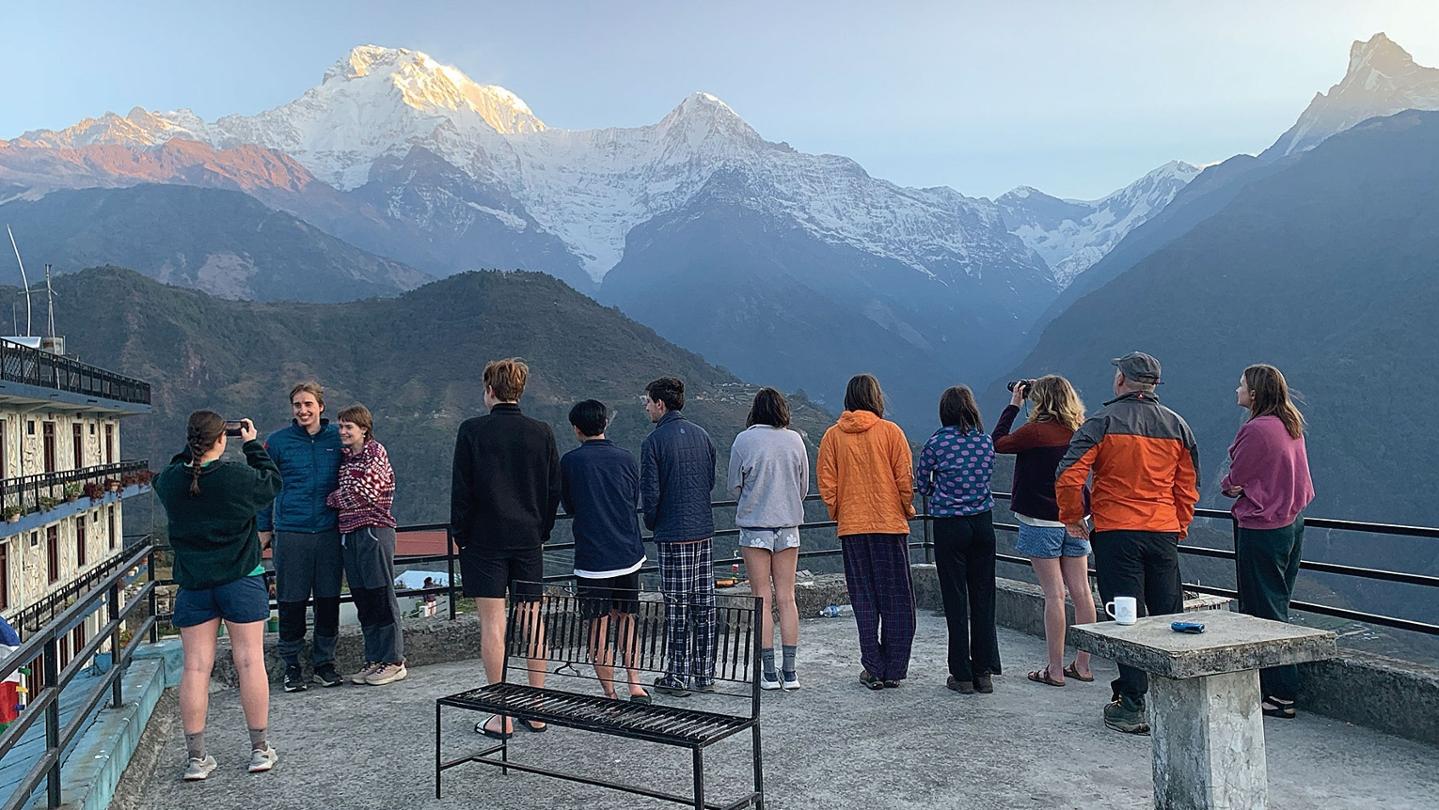
The next morning feels like the actual beginning of the trip. Chai arrives at 6 a.m. In an ageless tradition, our mischievous guides bang on doors, loudly announcing the morning tea. For the students, it’s their first experience of a jarring wake-up call immediately followed by a steaming cup of spicy milk-tea. This is standard in the Himalaya—morning caffeine meeting the culture of hospitality. For the students, it’s bleary-eyed bewilderment instantly replaced by surprised gratitude. A few minutes later, the members of our group, clad in shorts, pajamas and fleece jackets, step through their doorways and straight into the cold blue of predawn. They cluster on the roof as the mountains begin warming with the first tints of sunrise. The silence is intense.
With the light comes the first glimpse of the real Himalaya. Before us, the south face of Annapurna South (7219m) dominates the skyline. I stand back and fold my arms. This scene has played out for me countless times across the 2400-kilometer length of this range on over a dozen climbing expeditions since 1998. It is tempting to be blasé, but a Himalayan sunrise never fails to evoke awe.
The summit catches first light as a ribbon of molten red etches the highest rim of ice and granite. The glow bleeds down the summit pyramid, a languorous rollout of dawn. The sunlight grows, the yellows creep down snowy contours that are five kilometers higher and nearly fifteen kilometers distant from where we stand. Height, depth and distance revealed in the downward crawl of light. The yardstick moves on a scale so vast that if one hasn’t seen it, it’s hard to put into context—like watching the rotation of another planet. Dark barren planes of rock emerge as the light inches below snowline, taking on a lighter umber glow as it illuminates the smooth vegetated hills directly above tree line. Machhapuchhare commands the far eastern end of our rooftop view, the forked tail of its twin summits evocative of its nickname—Fishtail Peak.
The students are awestruck. All part of a graduating class of more than 500, few if any were friends prior to getting on the plane at JFK. They represent diverse backgrounds and a wide range of academic interests: biology, econ, political science, math. Somehow, in a way I can see but not quite understand, this place begins tying them together. They speak in hushed, muted tones, and as if on cue, the mountain air takes on the faint opacity that I’ve only seen in the dramatic light of the high mountains.
Successive layers of terrain are staged against preceding tiers, a series of massive and immobile props animated by the moving rays of sun. To even briefly look away risks missing something. The air becomes a fourth wall as the sun inches higher. The white intensity grows and in a quick moment the broad light flattens the scene. Just like that the drama is over. The students linger. They’ve just experienced the storybook Himalayan sunrise, a small but dramatic part of what draws climbers from halfway around the world. There is no substitute.
After dinner I send Isserman a set of pics from the last few days: the sunrise on Annapurna South, the wending and idyllic trail, the nightly celebration of dal bhat, chapatis and chai, a surprise birthday cake for Katie. Students who were recently strangers smile, clap and celebrate. In 2017, Anne McGarvey experienced a similar camaraderie. “It may sound cliched,” she wrote in her blog post, “but in the absence of familiarity and comfort, our group found each other. I have seen this same outcome time and again when people who hardly know each other spend enough time outdoors.”
Prior to establishing the Himalayan program, Maurice Isserman had developed experiential learning courses that incorporated the backwoods of the Adirondacks, long stretches of the Lewis and Clark Trail and the D-Day beaches of Normandy. In 2016, Sarah Skoy, associate director of Hamilton’s Outdoor Leadership program (who alternates leading the Annapurna trip, with Andrew Jillings), and a student named Gaby Pilson suggested that Isserman teach a course with an optional field trip, based on his book Fallen Giants.
In the class title, literature is given almost equal billing with history. “Mountaineering is a sport without spectators, which means the only firsthand accounts we have are from the participants themselves,” Isserman explains to me. “Fortunately, a remarkable number of mountaineers of the highest caliber—Eric Shipton, Bill Tilman and Tom Hornbein immediately come to mind—also proved first-rate writers.”
Besides authoring seventeen books, three of which are on mountaineering, Isserman has penned articles for Dissent, The New York Times, The Nation and The Chronicle of Higher Education. He’s also written for Alpinist. “I had three articles appear in it,” he recalls via email, “and—thanks to drillmaster [and then-editor] Katie Ives— they’re among the best things I’ve ever written for a periodical.”

For several days our group passes through idyllic villages with neatly terraced fields, livestock and teahouses. I’m growing fond of the students: Nate with his earnest inquisitiveness; Lara, whose aches and pains belie a fortitude that will soon earn her the Edgar Baldwin Graves Prize in History; Christina, the queen of mischief. In a photo taken after our arrival in Kathmandu, Christina, bedecked with the obligatory marigold garland, holds an enormous brick of rupees up to her cheek like a phone (expedition logistics are always paid for in cash). An impish grin implies she’s about to bolt—a suspicious shop employee watches in the background, arms folded.
Simon Le is a Vietnamese American econ major by way of southeast Texas. We don’t really connect until late in the trip, but I watch him absorb the deluge of new sights and sounds from behind his clear-rimmed glasses. On this day he’s wearing a floppy grey sun hat that flicks up as if in agreement whenever a breeze catches the brim, which is often. Behind his open smile his eyes sparkle with knowing amusement.
Later, he’ll write about this part of the trail: The journey … is physically demanding.… We crossed suspension bridges strung over high valleys, climbed stone steps carved into cliff faces, and pushed through cold mornings with each upward turn. But … the signs of commodification were everywhere: heated showers at every other teahouse, WIFI passwords posted beside laminated menus with coffee options, and branded trekking packages promising a curated Himalayan “experience.” … Red Bull and Snickers at prices calibrated to altitude … posters offering “horses for hire” or helicopter “rescue” rides for those willing to pay.
Our surroundings change with the elevation. The humidity drops and the air sharpens with the bite of altitude. We enter a dense oak and rhododendron forest that runs for six kilometers, maintaining a buffer between ourselves and some exuberant Nepalis ahead and a troop of chatty, loosely affiliated Chinese trekkers behind. We need space and stillness for our “solo walk.” Andrew explains that this is an opportunity for students and staff to hike alone and in silence for twenty minutes.
When Andrew talks, everyone listens. Broad-shouldered and unhurried, he carries the easy authority of someone who’s never needed to raise their voice. Yet. He’s director of the Hamilton Outdoor Leadership program, and in his twenty-plus years at the college he’s overseen the vast expansion of the popular Outing Club. He annually handles dozens of adventurous trips into the Adirondacks with eager students—climbing, backpacking, canoeing, etc. He runs this outdoor empire from the Glen House, a converted residence in a woodsy corner of campus, which is also where HIST 367 is held. The Glen House does not offer a conventional classroom setting, but rather a large common room where the students (and professor) sprawl on couches, easy chairs and beanbags for the weekly seminar.
Fourteen of the sixteen students choose to do the solo walk. Nate Cohen later writes that “the natural world centers you and fills your soul,” leading to “a deep sense of peace.”
I take part and try emptying my mind, but it doesn’t work; I slip into the shrill internal dialogue instilled by my many climbing expeditions. Though we did get grants and sometimes sponsorship, the majority were seat-of-the-pants affairs with teams composed of friends and fellow climbers. As the default leader of those trips, I carried concerns like: Did our visa extension get approved; did the trail wash out ahead; will Jonny stop yelling at the liaison officer; will the weather get better; will the weather get worse; will my girlfriend be around when I return; what the fuck am I doing with my life? Here, entering the Modi Khola Valley, in place of those past responsibilities I have the untraceable anxiety of someone who knows they have forgotten something important.
Breakfasts rotate daily, a combination of pancakes, porridge of oats or tsampa, boiled or fried or scrambled eggs, white or Tibetan toast, potatoes, fruit, butter, preserves and cornflakes. There’s even Horlicks malted milk powder for those in need of that protein kick. Hot milk accompanies chai, cocoa, black tea and the ubiquitous Nescafé. A hefty percentage of coffee consumed worldwide is instant, yet Americans treat it with disdain. The students watch as Lara, a part-time barista, demonstrates the instant coffee latte by fork-frothing Nescafé before adding milk and sugar. It actually tastes like Starbucks. Fully caffeinated, I rush off to tend to my morning ablutions as the tinny percussion of a half dozen forks fades into the background.
I’m not trained to teach but I can wing it when the need arises. Over the days, I walk the trail among the students, who collect in small knots based on shared affinity, academic interests or pace of ascent. In one memorable interaction, a group of six or seven shares animated observations that include diverse interpretations of our surroundings, some cultural, some scientific and some historical, but all ignited and infused by the immediacy of the Himalaya. Eileen, a biology major, later writes that as they “began our trek, my perspective shifted dramatically” and it was “experiential learning at its finest.” Simon notes that “every day felt like stepping into the syllabus. We literally saw our classroom come to life. Everything we had studied—Imperial exploration, the Sherpa labor economy, even the romanticism of the mountains—was right there.”
It’s good on occasion to view the things that we hold dear at a distance. History offers that chance—to see clearly without the distortion of the immediate. The mythology we’ve inherited or created about Annapurna, climbing and the Himalaya themselves amounts to a lens that warps what we’re actually seeing. It helps to look through the eyes of others.
Prior to the Annapurna trek, I visited Hamilton College. I learned that it was ranked fourteenth among National Liberal Arts Colleges by US News & World Report. That’s the kind of credential administrators guard and faculty dismiss.
Hamilton is also small—about 2,000 students—and located on a rural hilltop above the village of Clinton, New York, an hour’s drive from the Adirondacks. The quiet maple- and oak-shaded streets conjure the eighteenth century and belie an intense academic environment.
Isserman showed me the sights, including the bronze statue of Alexander Hamilton. The statue is less a memorial to the institution’s founding and more an exercise in co-branding. All 1,000 pounds of it disappeared in 1980, only to be discovered two months later in a dump ten miles away. The weight of the bronze itself ruled out a drunk frat prank and the mystery remains unsolved.
In his office, I asked Dr. Isserman, “Why is history important?” I had my own opinion, but it was hard to articulate and I was hoping for an easy, elegant answer. In my imagination, this was the type of thing he’d produced while in the company of other historians. It later felt like a fool’s errand. Asking Maurice why history is important was like asking me why climbing is important—it just is. The tall, bespectacled Isserman chuckled. “That’s a question you never ask historians,” he said.
In the emails and phone calls prior to departure, I was tempted to revisit that first question: “Why is history important?” The answer needed to be easy to grasp—pithy, not glib—and possess as yet unconsidered implications. Something clever, memorable and repeatable, like “Those who cannot remember the past are condemned to repeat it.” That one has popped up quite a few times (never with Isserman), and like many a good quote in search of a great author, it is often misattributed to Churchill, Twain or Einstein. (It was George Santayana who wrote those words.) But it would be akin to having an enthused non-climber ask me if the reason I climb is “Because it is there.” While true, such statements are not the truth.
What is true is that Isserman started climbing during his years at Reed College in Portland. If academics and politics influenced his worldview, then the vertical world shaped his values. In his as yet unpublished memoir, he writes, “Finally, I had found an athletic activity I was reasonably good at … David [climbing partner] and I became climbing fanatics, going rock-climbing or, in season, mountain-climbing, on every available occasion.”
According to his memoir, this era had a “preternatural clearness.” The new environmental ethos of “clean climbing” appealed to him, and he found the ongoing “Rucksack Revolution” attractively egalitarian. He writes, “Those climbing days and nights in 1973–1974 were among the best moments of my life. My inner Thoreau grew to maturity that year. And the seeds of my three mountaineering books in the [twenty-first] century were also being sown.” He adds that climbing, “and the comrades I met along the way, shaped and determined who I had become, and who I would remain, for the rest of my life.”
The enacted idealism that brought Isserman to Cascade summits like Mt. Hood and Mt. St. Helens, and up the basalt walls of Broughton Bluff and Beacon Rock, also served him well in academia. He went on to become a leading historian of American political radicalism. He was elected to the Society of American Historians, was awarded two Fulbright lectureships, won several National Endowment for the Humanities awards and earned a Mellon Fellowship at Harvard.
In 2008, he returned to climbing by way of mountaineering history, co-authoring the Banff Prize–winning tome Fallen Giants with Stewart Weaver. He went on to write Continental Divide: A History of American Mountaineering, published in 2016, and The Winter Army: The World War II Odyssey of the 10th Mountain Division, released in 2019. His next as yet untitled book examines the global history of mountaineering.
In the Modi Khola Valley the trail sees a lot of up-and-down traffic, mainly Chinese or domestic Indian and Nepali tourists. This is a big change from my first visits to this range in the late 1990s and early 2000s. Back then, I felt like a neocolonial with my American dollars, fancy gear and climbing skills honed by living on the fringe of an affluent society. The trail then was populated almost entirely by European, North American and Japanese visitors. While there’s still a lot of Arc’teryx, TNF and La Sportiva apparel to be seen, these brands are being crowded out by top-notch Indigenous labels like Sherpa Adventure Gear and HIMALI. The local populations are reclaiming their backyards, owning the businesses that profit from the mountains and fabricating the clothing and hardware. They’re also owning their summits—in January 2021, an all-Nepali team claimed the first winter ascent of K2, the last 8000-meter peak to be climbed in the most difficult season, and Sherpas have gone from playing supporting roles to dominating Himalayan speed records.
We pass through glades of bamboo before exiting the tight confines of the Modi Khola canyon. The forested walls rise for thousands of feet, blocking any view of the surrounding 7000- and 8000-meter summits.
“In the nicest way possible, I’d tell them that I have yet to climb anything just for a summit (not entirely true) and that style has always mattered most to me (also not entirely true).
The next day we ascend above tree line and into the alpine zone. The raw bones of the Himalaya begin poking through the vegetation. Arêtes, sharp buttresses and bands of gneiss emerge from near-vertical forests of rhododendron. Higher up the valley, massive walls pinch to pointy summits, countless and unnamed.
We stop at Hinku Cave, a building-sized boulder that fell from the cliffs above and landed in just such a way as to form a deep weatherproof niche under its overhanging flank. Andrew suggests I deliver a brief lecture on what we’ll get to see (weather permitting) when we get to Annapurna Base Camp.
Getting the attention of excited youngsters is something outside of my life experience. I start by rattling on about the historic precedent set by Bonington’s 1970 British route, the technical nature of the south face and the divergence of styles that were applied in the ensuing years. I’m losing them. Some politely smile and others pay no attention. I realize it’s not because they are bored, but because they already know all this from the class material. I’m hard-pressed in my world to find a pair of fellow climbers who know, much less care, about any of this.
I’m about to launch into how the application of postwar technology and semi-military hierarchy defined the early Himalayan successes when the raconteur in me steps in. “So … besides the hundreds of pitons and carabiners, the Brits brought twenty bars of soap, seventy-two bottles of whiskey and 14,000 cigarettes …” There’s some interest in this.
Cate raises her hand. “Any idea how much toilet paper?” There are a few belly laughs and some nervous chuckles, the latter from those for whom the question has real weight. Andrew closes our break with the afternoon itinerary. Clouds gather. It looks like some weather is coming in.
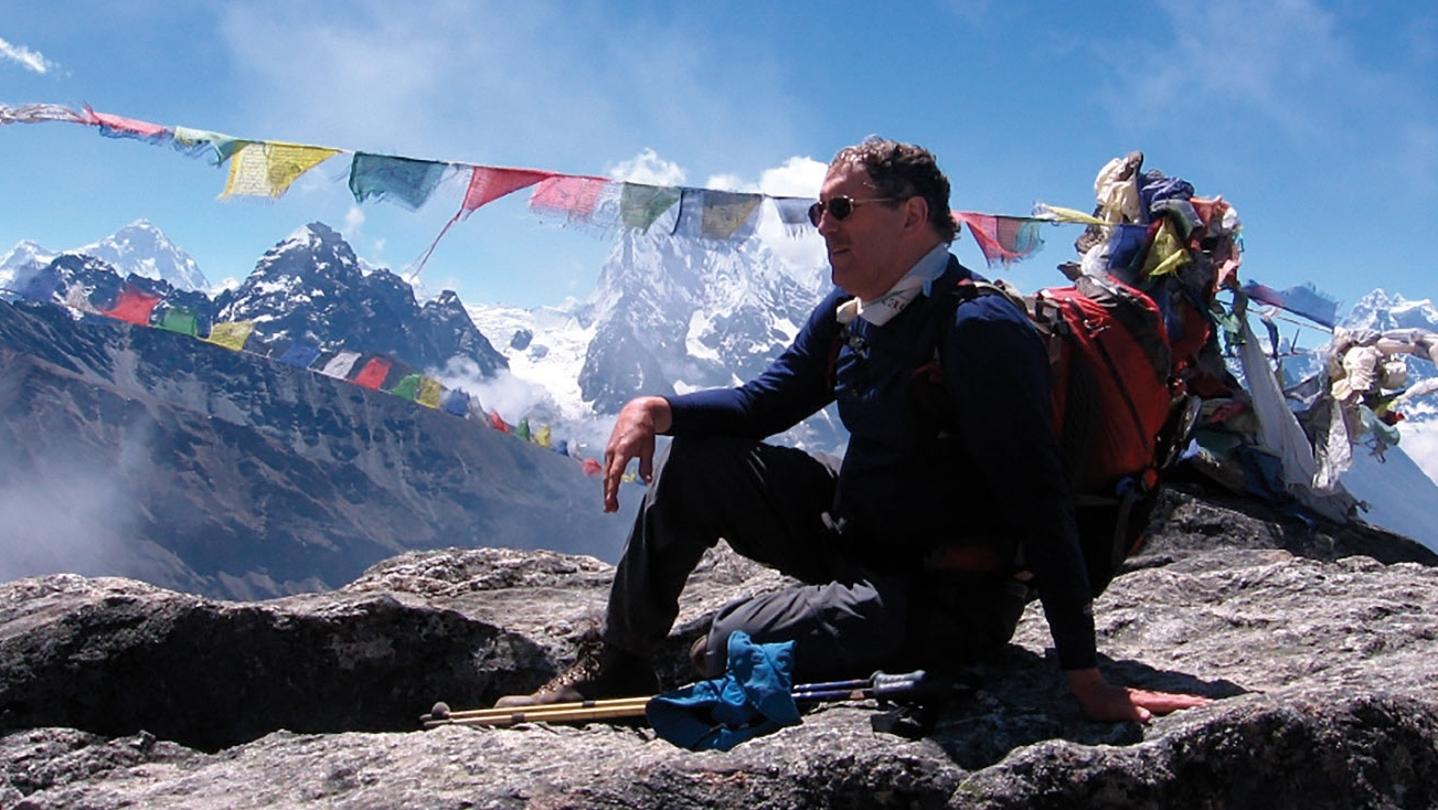
Maurice Isserman was born in Hartford, Connecticut, in 1951 and grew up fifteen miles to the east in the small town of Coventry. “With a Quaker mother and a Jewish father,” he writes in his memoir, “coming of age in a community where what passed for ethnic diversity ran the gamut from Yankee Protestant to Irish Catholic, my early desire to fit in … gave way to an even stronger desire to escape the whole lot of them.”
The seeds of escape were in part sown in 1967 when Isserman, just sixteen at the time, attended a protest regarded today as the highwater mark of 1960s activism—the March on the Pentagon. He revisits this formative experience in “The Flower in the Gun Barrel,” in The Chronicle of Higher Education: Toward dusk … a burly federal marshal took hold of my feet, dragged me away from the plaza in front of the Pentagon … before depositing me on the pavement of the building’s north parking lot.… I picked myself up … and limped back across the bridge connecting Arlington, Va., to Washington. All in all, I thought, it had been the best day of my life.
This political coming of age matured at Reed College. There, he joined Students for a Democratic Society and participated in further anti–Vietnam War activism for the next two years. He left Reed in 1970—in the wake of the US invasion of Cambodia and Kent State. He told me it was “to form a revolutionary youth collective in Portland.” But he returned to Reed for the spring semester of 1972, he said, after “figuring out over the next year and a half that The Revolution had unfortunately been indefinitely postponed.”
Isserman left Portland—and climbing—to study history at the University of Rochester in New York. In a reverse parallel, I dropped out of college to climb in Yosemite. He’s become a bit like the father I never had, one who really understands the thing on which I mortgaged my life.
We first met as mutual friends of Tom Hornbein. When I came to understand the Hamilton program, it slowly dawned on me what it meant. Nowhere else in the US does something like this exist. HIST 367 validates a pursuit that often descends into blind self-obsession. Amid the pedantry, chalk dust and dirt there is often little reflection beyond the mechanics of ascent. As author Jeff Long reminds us, “We take our mountain literature for granted, but should not. Without it, there is no ascent, just pullups and beer.”
For three years running, I logged in remotely to Isserman’s class for a discussion of my two-part Nanda Devi Mountain Profile in Alpinist 62 and 63. Each time, talk inevitably drifted to questions about the fun stuff: Who’s the best climber? Have I ever been almost killed? Do I know Alex Honnold? Eight-thousand-meter peaks would also come up.
In the nicest way possible, I’d tell them that I have yet to climb anything just for a summit (not entirely true) and that style has always mattered most to me (also not entirely true). I would then deliver a stock recitation of how 8000-meter peaks hold little allure for me, while implying that they aren’t real climbing. This was all a subtle and slightly dishonest way of glossing over a big omission in my all-around-climber résumé—one that I took secret pride in.
To my surprise, the students understood the nuances. They’d preempt whatever I had teed up by way of denial with well-crafted rhetorical questions like: “We know Everest costs a lot, but have you done it?” or “Have you ever wanted to climb an 8000-meter peak?” I was always uneasy about that last one, but I’d reply with a well-practiced “Nah.”
We spend the night at the Super Top Lodge, a tidy two-story building with the ever-present deck made of hand-trimmed slates. That night I send Isserman an email update. He responds with an almost fatherly concern for his students—and plenty of pride that everyone has made it to 3700 meters (12,100') with nothing more than a few headaches.
A day later the weather is socked in when we reach Annapurna Base Camp at 4130 meters (13,550'). The mountain views we’ve hoped for are nonexistent, and the forecast doesn’t guarantee that the clouds will clear. A familiar tension hangs over us in the crowded dining room. Perhaps sixty trekkers and guides crowd on benches along the row of tables placed end to end that run the length of the room. The atmosphere is thick with steam from food and drink being prepared on roaring kerosene stoves. The windows are fogged with condensation, not unlike the cloudy nothingness that wraps Annapurna.
Lodging is limited at base camp, so Calvin, Billy, Zach, Xavier, Andrew and I crowd into one small metal-walled room. In the faint glow of my Kindle, I read from Annapurna South Face. Dougal Haston describes arriving on the summit in 1970: “We didn’t speak. There was no elation. The mind was still too wound up to allow such feelings to enter.… The greatest moment of both our climbing careers and there was only a kind of numbness. But we knew the elation would come when we unwound.”
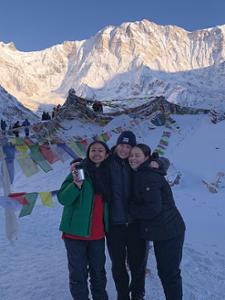
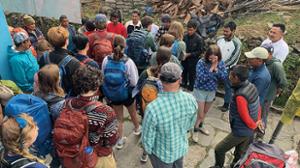
Before turning the Kindle off and stuffing in my earplugs, I send Isserman some more pics from the last few days with the news that everyone successfully reached the apex of our journey. He writes back, “Send my congratulations to my mountaineers.”
Isserman participated in the first Annapurna trek with the students. It was also to be his last. He recalls with wry humor: “I turned sixty-six on the flight to Kathmandu. I had a great time in the Himalaya and returned to spend the next six months in physical therapy, since keeping up with twenty-somethings on Nepal’s rough trekking trails at altitude was not, specifically, my best decision ever.”
Moments later I sense movement in the room, pull my hat up and sure enough, ten hours have passed. Headlamps flash in that familiar staccato morning ritual. I ask, to no one in particular, “Is it clear?” A light flares straight into my eyes and I hear Andrew’s voice. “Yes, perfectly clear.” I bolt upright and pull it together. Then I head out the door.
Everyone scatters for an ideal perspective. It’s proper cold and Annapurna’s dark outline blends against the sky. No summit anxiety here—just the indulgence of anticipation without its misery. I wait.
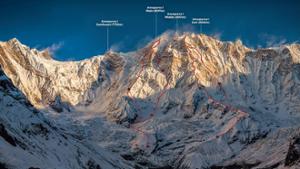
At 5:53 a.m., the rising sun strikes the rim of the massif, three miles distant. Orange light creeps down the face. Amber rock, lavender snow, blue-grey ice. I begin tracing the key features of the 1970 British route from the top down. Foot by foot the golden granite wall above and below Camp VI comes into the light—this El Cap–sized rockband took several weeks to climb and fix. Below it, Camp V, then Camp IV at 21,300 feet. The vast section of bottomless snow, steep ice and mixed terrain that required a month to climb. The Ice Ridge, serrated by a series of formidable towers. Finally, Camp III, the broad saddle above the initial 1,500 feet of climbing—and below it, the gully where the expedition’s only fatality happened.
Simon is somewhere off to my left with a gaggle of students. He’ll reflect on this moment in his HIST 367 term paper, “The Business of Death: Commercialization, Risk, and Spectacle in Himalayan Mountaineering”: “Watching the sun rise on Annapurna was intense. I remember reading Robert Macfarlane’s line that mountains are ‘a collaboration of the physical forms of the world with the imagination of humans,’ and that hit me hardest once I got to base camp.… It felt like I had finally walked into a myth.”
I can’t think of anywhere else on Earth where the full arc of cutting-edge Himalayan climbing is written on a single face. The British route was a step into the future—but also its own rebuttal. A year later, in his 1971 essay “The Murder of the Impossible,” Messner decried fixed ropes and large teams as a betrayal of what mountains demand. The British route was brilliant and massive and, almost immediately, obsolete.
A few short years brought what the book Himalaya Alpine-Style calls the Golden Age. In 1984, two Catalans—Enric Lucas and Nil Bohigas, both in their twenties, with no Himalayan experience and two girlfriends in base camp—climbed the south face in pure alpine style. No fixed ropes, no camps, no load carries. Lucas wrote in The American Alpine Journal that they set out with fifty-five-pound packs holding food and fuel for seven days, two ropes and enough hardware to rig rappels on the 2000-meter descent. They endured rockfall through the zone where Alex MacIntyre had been killed by a single falling rock in 1982—Messner had called MacIntyre “the purest exponent of the lightweight style now climbing in [the] Himalaya.” They took multiple leader falls through the technical crux. On Day 6 they reached the middle summit at 8051 meters, then descended, using their last piton as the final rappel anchor. Lucas later said they made it because they didn’t know it was impossible before leaving Barcelona.
The Catalan Route destroyed and rebuilt climbing’s paradigm in a single week. Few people today can even name the two climbers. Then came Ueli Steck in 2013. Now when I look up at the face, I see a curriculum.
The truth can be less revealing than the rancor or agreement generated by a claim. These things tell us more about ourselves than about the veracity of the claim itself.
In 2013, Ueli Steck claimed a twenty-eight-hour solo ascent of the south face via the line attempted in 1992 by Béghin and Lafaille. Elizabeth Hawley noted that the difficulty and scale of Steck’s endeavor elevated his climb to what was “already being hailed as one of the greatest achievements in modern Himalayan history.”
The climb also quickly became one of the most contested in the history of alpinism. With Steck now almost a decade gone, there’s no simple conclusion in sight. What is unarguable is that the controversy is now a part of the face’s story. Maybe one of these students will go on to prove or disprove Steck’s claim.
Simon later writes in an email, “Before the trip, the history [and] literature of Himalayan mountaineering felt like a niche subject and maybe dad lore for my future kids.… But after being there, I get why it matters.” He adds, “When you’re hiking the same trails you read about it’s just different.… That connection (that back and forth between books and the real world) is what made it meaningful. It’s not just history anymore. It’s something we’ve walked through.”
The spectacle of the south face brings up a well of feelings that will take a long time to understand. I don’t know how to fit it into my worldview, but I know that the cumulative years I’ve spent in this range have given me a view that is very deep, and very narrow. Later, I write about this in my journal: Felt self-absorbed behind an accumulation of experiences, many of those in close proximity of mortality. Intense. How easy it is to drift. I think it’s OK for me as an individual and if anyone had asked me at their age if all experiences are good, I would have spoken an emphatic “Yes!” Now, watching these young students, their whole lives yet to be lived, I think about a quote from Cormac McCarthy: “The things you put into your head are there forever, you might want to think about that.”
You can’t get rid of what you’ve seen or what you’ve done—the beauty and the sorrow, the joy and the pain. As my former mother-in-law told me before I departed in an almost cavalier fashion to recover a dead friend near Gongga Shan, “That’s a hard road.”
I can see how the same accumulation of experience that qualified me to be here has also, in a subtle fashion, cost me something. I’ve stood at a dozen advance base camps multiple times, on multiple expeditions—with similar fears, logistics, partners, objective hazards all sharpening my attention. And yet these students, on their first visit, armed with Shipton and Tilman and a semester of Isserman, saw something I’d stopped seeing.
I’ve climbed with the greats, from Bachar to Lowe, Sherman to Hill, and repeated their routes to further understand them. That was always my method—I learned by doing, by consuming rock, ice and snow. But I always resisted history, at least my own. I voraciously read up on past wars or politics, but I could never fully trust my memories and experiences the way I trust the climbing medium. In some ways, to fully trust them felt like conceding something I couldn’t do without, or perhaps admitting that I was done.
Then I watched sixteen students walk into a myth they’d read about in a classroom in upstate New York, and something cracked open. Because they had the history first, the mountain landed differently for them. And watching them, the mountain landed differently for me too—as if seeing something intimately familiar … for the very first time once again.
Isserman has taught me that bearing witness to climbing history is itself a form of climbing. It applies to both of us, but differently. He climbed history into being by writing his books and building this course. I climbed my way to an understanding of why it matters. These students are the proof. I can’t explain it, but they are somehow pulling me back from an abyss filled with personal knowledge and experiences that are not quite wisdom but a corrosive knowingness. People cut off from their history don’t just lose context, they lose themselves. They become smaller than they could be.
The following days consist of different scenes and scenery, vignettes cemented together by a practiced routine. On long trips it can begin to feel that life has always been this way—that the world back home is less real than what’s immediately underfoot. We have two days left in the Himalaya, but I already know I’ll be back. This certainty is because an idea nags at me—the one thing missing from my climbing experiences is the summit of an 8000-meter peak.
A year after the trip, Simon writes: What’s stayed with me most from the trip and the course is the reason to do something doesn’t always need to be more complicated than the fact that it exists. That George Mallory line about climbing “because it’s there” stuck with me in a way I didn’t fully expect at the time.… Not everything needs to be explained or justified beyond recognition, sometimes the simplest reason is the most honest. What’s stayed with me is the paradox that the mountains themselves don’t change, but the experience of them always does.
Isserman Contributes to Fall 2026 Alpinist
The fall edition of the Alpinist will include a story by Maurice Isserman about the British mountaineers Eric Shipton and Bill Tilman, and their reconnaissance and ascent of Nanda Devi in the Himalaya in the 1930s.
Near Chhomrong our trail loops through oaks, pines and patches of scarlet-trunked rhododendron. These are tucked away in pockets and folds in the hillside, each with its own microclimate. The trail gains elevation and starts running the crest of a low ridge as the trees open up. Due north a faint pinkish splotch hovers in the sky.
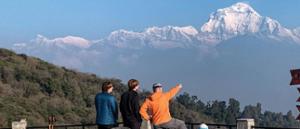
Andrew has keen instincts and an uncanny sense of timing. As proven time and again on this trip, he seems to know what his students are thinking about doing before they’ve decided to do it. He taps my shoulder. “Pete, there’s Dhaulagiri.” He points with his trekking pole just as the clouds part and the light breaks over the peak. At 8167 meters, the seventh-highest peak in the world hovers like a luminous disembodied apparition. Abrupt, arresting and forty kilometers distant, it flickers as if in motion due to the refraction of light. The clouds slowly roll back in; Dhaulagiri hangs in space before fading into a few brushstrokes of pink. And then just like that, it’s gone.
