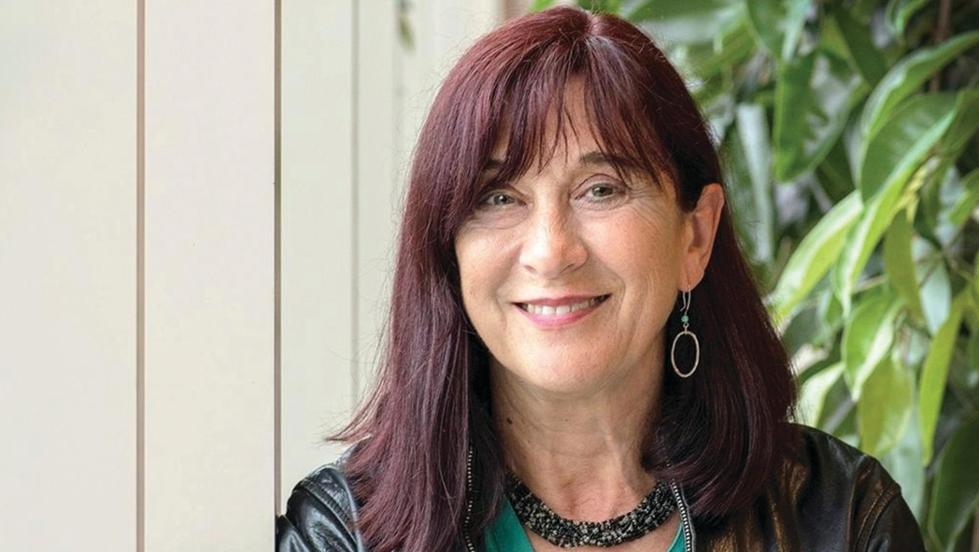
The experience will also bring an unexpected Hamilton connection. Guyot-Bender’s point person in the U.S. Embassy in Cambodia will be Sara Feuerstein ’08, whom she taught more than 20 years ago. After studying French at Hamilton and participating in the College’s program in Paris, Feuerstein went on to work for the U.S. government and is now stationed in Cambodia. Although the two have not worked together since her time at Hamilton, their paths will cross again as Guyot-Bender begins her Fulbright.
We asked Guyot-Bender about her research and what she hopes to take away from this experience. [Responses excerpted and edited for length.]
What will you be studying in Cambodia?
The research I’ll be doing [concerns] what makes the new art house cinema of Cambodia, Cambodian. I’ll be studying contemporary film in Cambodia and looking for commonality. There’s some kind of a common goal of the new cinematographers, and there are only a few of them. It’s a very new cinema that nobody knows anything about, so I’ll be looking at how they represent not their country, but their society, which is moving forward toward modernization.
Cambodia was a French colony, part of Indochina, until 1953, and they had a king at the time [Norodom Sihanouk]. Even though he managed to get the country independent from France, he was enamored by French cinema. Right after the independence, he started to create a new cinema. So he was kind of copying the colonial power, and in 15 years, they made 400 films and there were 30 cinema theaters in Phnom Penh. Then in 1975, the Khmer Rouge arrived, a communist faction, very violent, and cinema disappeared. So it’s a country that had for a brief time a dynamic cinema scene that went to nothing in very little time, and it has taken about 25 years for cinema to come back in any meaningful way. That’s what I’m looking at: the renewal of the cinema. I’m starting in 2000 — until then there were hardly any films made since 1975. It’s complicated. It’s hard to understand without [understanding] the history.
What is the importance of this project?
Well, I think about it every day. Who cares? Why does it matter? I’m French, and I believe that cinema is a major part of culture. It translates ideas and ideals in ways that are very tangible because of moving images. So I have that in me. For them, it’s really important because it is giving them a name in Southeast Asia. Cambodia suffered the most of the colonial powers, and then they suffered the most in the region because of the Khmer Rouge. It took them a long time to find an identity after independence, longer than any of the other Southeast Asian countries. So, does it matter? It matters to me. And I’m trying to support them the way I can with my research.
How did you become interested in this topic?
It will be my personal history here. I did my dissertation in two books — one book has a collection of essays on the memory of the Holocaust in France. And then I moved to social documentary films, and this is how I discovered what they were doing. But I’ve always been interested in memory after trauma; how you get out of a period of intense suffering, which this country has not had, really, on the ground except for 9/11. How do you get out of this terrible period and try to do something?
How do you think this experience will inform and inspire your work back at Hamilton?
I already know that I will have to rethink a lot of my teaching strategies. I don’t know what I will bring back, because it’s difficult for me to imagine myself becoming an authority. But I think I will also learn from people who work at the university. I will be in contact with other professors, and we’ll be talking. I’m very close to retirement. But I really hope that I can teach before I retire, that I can teach a whole class on Cambodian cinema. This is a part of my project, to infuse more Southeast Asian information. I would really like it if I’m able to teach a whole class on cinema from the Golden Age in the 1960s, to the disappearance of cinema, to the rebirth of cinema.
Posted August 14, 2026