
The project, Expanding Science Frontiers through Continental Drilling, is led by Anders Noren, director of the University’s Continental Scientific Drilling (CSD) Facility. Partners include Brown University, Hamilton College, Missouri University of Science and Technology, the University of Notre Dame, Arizona State University, Syracuse University and the University of Wyoming.
With funding secured, the project team will seek input from researchers who use drill cores to study past hydrologic conditions, climate, ecosystems, geology, biology, and human history. Their feedback will help shape a platform that serves a wide range of research needs.
“Acquiring this infrastructure has been a long-term goal of the scientific drilling community so this is a major step forward. These funds will enable us to dream big with our science and collect records previously inaccessible with the previous technologies,” Beck said. “Along with the investment in the modular platform, these will also be educational components of this grant that will translate directly back into courses I teach at Hamilton, such as using 3D printed models of the barge components to give students a chance to design and “build” their own lake-based coring project.”
“These funds will enable us to dream big with our science and collect records previously inaccessible with the previous technologies.”
Plans for the new platform consist of transportable modules that can be shipped and assembled for each expedition. The CSD Facility is inviting prospective users to help refine the design through workshops and other opportunities for input. Researchers can identify the equipment, sampling capabilities, and working conditions their projects require. A cohort of early-career researchers and marine engineers will contribute to the platform’s development through a traineeship program.
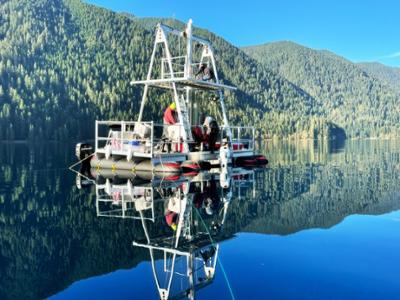
“Scientists have clearly documented the need for this capability in white papers, published articles, and proposals,” Noren said. “This platform will give them access to high-priority sites that can answer frontier scientific questions. And because a single core sample can serve researchers studying numerous topics across decades, the value of an expedition extends well beyond any one project.”
Drill cores are cylinders of sediment and rock recovered from beneath the surface. Their layers preserve evidence that researchers cannot collect in other ways. Because scientists studying different questions may need samples from the same site, one expedition can serve several teams and allow them to share the cost.
The CSD Facility provides the equipment and expertise to make that work possible. Its staff help teams plan expeditions worldwide, train researchers to collect and analyze cores, and manage the curation and use of samples and data afterward. These shared resources allow scientists to pursue projects without each team having to handle all logistics or build and maintain their own equipment.
This newly announced NSF infrastructure funding complements Beck’s Turkana Basin Drilling Project (TARGET): Exploring links between environmental factors and hominin evolution over the past 4 million years, which received $1.9 million for Phase 1 of the project which will drill on land from the International Continental Scientific Drilling Program (ICDP). Phase 2 of this project will rely on this modular platform and one of the grad student/postdoc trainees this summer will likely be mentored by Beck in planning how the platform would be used on Lake Turkana for TARGET.
Posted November 11, 2026
