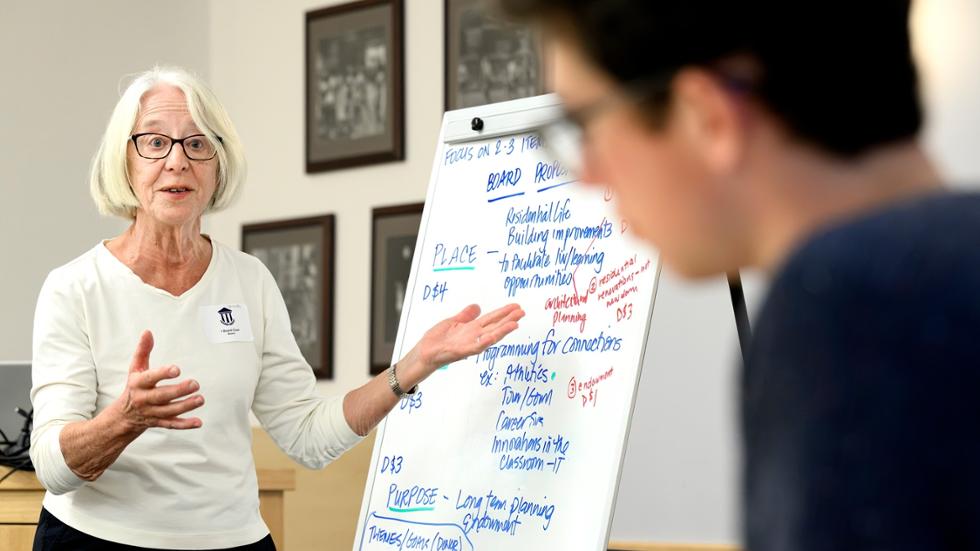
That was the challenge facing participants in a new role-playing game developed by Common Ground, Hamilton’s civil discourse initiative, on Homecoming Weekend. The event invited attendees to step into the role of college stakeholders and negotiate how to allocate a major gift, offering a hands-on look at how competing interests and conversation shape institutional decisions.
The fictional college had budgeted 65 “donor dollars,” each representing $1 million, before a donor offered an additional 10 donor dollars. Participants took on roles including the board, college president, faculty provost, dean of students, athletics director, and student body president. Each had specific interests to advocate for, while the group needed to agree on an allocation that would secure the donation.

“The challenge is figuring out how to balance competing priorities and distribute resources in a way that makes everyone happy, especially the donor,” said Ty Seidule, professor of history and executive director of Common Ground.
The exercise also introduced an element of uncertainty. Although the donor was initially indifferent to how the money was spent, participants could influence his priorities by making a case directly to him. Those conversations illustrated how individual voices and relationships can shape collective decisions.
Seidule created the game to help people both understand how a college works and explore how roleplaying facilitates learning. He is testing its potential for a future Hamilton course, building on other game-based courses he teaches, as well as its possible use at other institutions.
“One of the things I love about this kind of learning is that you’re part of a team,” Seidule said. “You learn through collaboration and discussion, and you see how people’s decisions can shape the outcome.”
“One of the things I love about this kind of learning is that you’re part of a team. You learn through collaboration and discussion, and you see how people’s decisions can shape the outcome.”
Owen Fellows ’29, a Common Ground student ambassador who played the donor, saw the game as an opportunity to involve community members in a complex process.
“Events like the President’s Game are important because they provide an opportunity for members of the Hamilton community to take part in a process that they otherwise would not have even known existed,” he said., “and in doing so, contribute to Common Ground’s core mission, which is participating in civil discourse with your peers.”
The negotiations also demonstrated the importance of building relationships beyond one’s assigned group. While participants could advocate for their own interests, Fellows observed that forming coalitions across stakeholder groups and combining their influence offered a more effective path toward a shared outcome. He reflected, “Communication between opposing factions is critical if you want to get anything done.”
During the post-game discussion, participants reflected on the importance of communicating before decisions are finalized. One alumnus noted that a course built around the game could help students better understand how the college functions, from the role of the board of trustees to how endowments operate. The process revealed how many stakeholders and competing considerations are involved in allocating institutional resources.
Fellows hopes the game will lead to more opportunities for the Hamilton community and extend beyond a fictional college. By putting participants in the middle of negotiations, the President’s Game and others like it will demonstrate how civil discourse can move beyond discussion to become a practical tool for collaboration and collective decision-making.
Posted October 14, 2026