
I am writing to share the sad news that Winslow Professor of Classics Emeritus Carl Rubino died earlier this week. A member of the Hamilton faculty beginning in 1989, he continued to teach occasional courses in the Classics Department following his retirement in 2016.
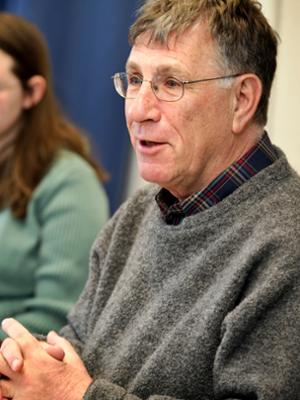 Carl taught and published extensively on ancient Greek and Roman literature, comparative literature, philosophy, literary theory, and the relations between science and the humanities. He served on the editorial boards for a number of professional journals, including The American Journal of Philology, the oldest classical journal in the United States. Carl was also a past president of the Classical Association of the Atlantic States, and was a member of the core faculty for VRoma, an NEH-funded project dedicated to exploring the resources of technology for teaching and learning classics. He collaborated with the Belgian physicist and 1977 Nobel laureate Ilya Prigogine, and organized conferences dedicated to the work of Umberto Eco, the Italian medievalist, philosopher, semiotician, novelist, and cultural critic.
Carl joined the Hamilton faculty following a 17-year distinguished career at the University of Texas at Austin. He also taught at St. John’s College in Annapolis, Santa Clara University, Le Moyne College and Bellarmine College, a Jesuit seminary. At Hamilton, he originated College 100, an interdisciplinary seminar for entering students; started the lecture series at The Other Side in Utica that is now named for him; and for more than a quarter-century, arranged an extensive and wide-ranging offering of lectures for the Classics Department.
Carl was also intrigued by our College’s namesake and contemporizing classics. In 2003, he traveled to Nevis in preparation for teaching the Sophomore Seminar, “Cicero, Hamilton and Jefferson.” He subsequently co-taught with Frank Anechiarico “Hamilton, Jefferson, and the Classical Tradition, which led to him giving tours of Hamilton monuments and museums, and even to be part of a reenactment of the Hamilton-Burr duel. Earlier, he appeared on the History Channel in a Lucasfilm documentary “Star Wars: The Legacy Revealed,” where he discussed the films’ roots in mythology.
Barbara Gold, his wife and Classics Department colleague, described Carl as “an extremely versatile teacher” who demonstrated an incredible “range and depth of knowledge, enthusiasm for teaching and intellectualism.” She said he was “respected by a great many faculty and students at Hamilton.”
Carl received the Dean’s Career Achievement Award in 2016. One nominator summarized his contribution to Hamilton: “Throughout his long and distinguished career, Carl has always strived to show how classics is the bedrock of the humanities, even in modern times. He has searched for the impact of classics on both the deeply intellectual (like complexity theory) and popular culture.” Said another, “Carl has been a consistent presence in the academy, not just in classics, through his many articles and presentations. He is really unusual in the field of classics — I would even use the word unique — for his variety of interests.”
Carl was born and raised in Syracuse. A former Jesuit, he earned bachelor’s and master’s degrees in classics from Fordham University, a Licentiate in philosophy from Loyola Seminary-Woodstock College, and a Ph.D. in classics from the State University of New York at Buffalo.
Appropriately, according to Merriam-Webster, reminiscence is an “apprehension of a Platonic idea as if it had been known in a previous existence.”
Posted November 5, 2026
