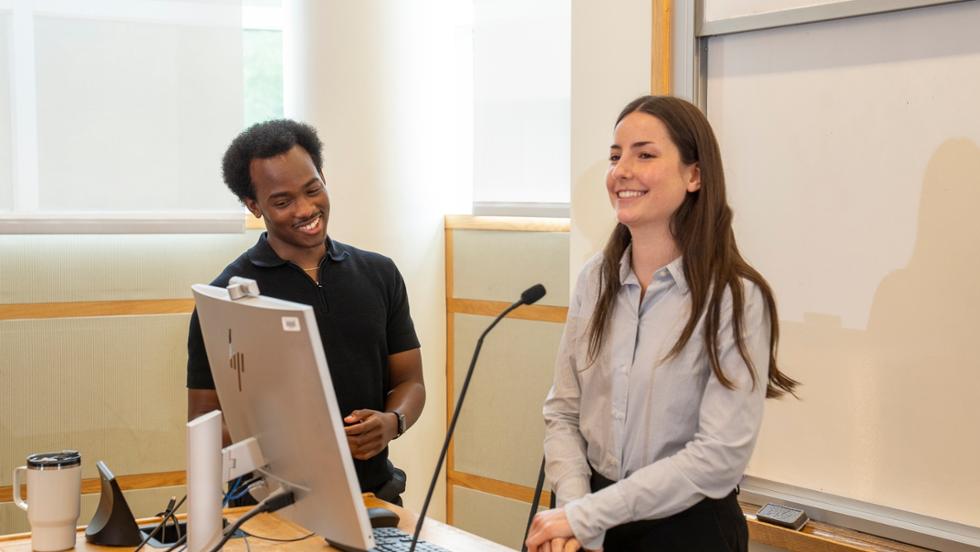
Launched this summer as a pilot program, the Hamilton Impact Learning Lab, (HILL Fellowship), brings together leadership development, hands-on internships, and experiential learning. Nine students, ranging from rising sophomores to a recent graduate, spent 10 weeks working with regional organizations, meeting industry leaders, and exploring leadership across different fields.
A key partner in bringing the program to life is the Griffiss Institute, a Rome-based technology and innovation organization with longstanding connections to Hamilton. The fellowship grew out of Hamilton’s Aspirational Design process last year, when a group that included Griffiss Institute President and CEO Heather Hage ’02 began developing the idea of connecting students with leadership education, hands-on experience, and opportunities in the surrounding area.
The concept continued to take shape through collaboration among Hamilton faculty and staff, the Griffiss Institute, and the Career Center. Griffiss now plays a central role in the fellowship, helping provide internship opportunities and connect students with industry professionals.
“We are trying to connect leadership training to the liberal arts,” said Nathan Goodale, associate provost and professor of anthropology, who has helped organize the fellowship. Rather than focusing only on leadership theory, he said, the fellowship gives students opportunities to put what they have learned into practice.
Each week was organized around three components. On Mondays, fellows participated in leadership development sessions led by Daneli Partners, co-founded and led by David Casullo ’84. Tuesdays through Thursdays were spent at internship sites, while Fridays took students throughout Central New York to meet with leaders and learn about innovation and entrepreneurship.
For Greta Andelman ’29, that combination was a major draw.
“I wanted the opportunity to see what office life was like and actually work a traditional 9-5,” she said. “But I was also worried about being stuck at a cubicle five days a week, so this gave me the chance to do both.”
Andelman interned with the Oneida Innovations Group, where she worked on a new HR technology platform designed to support hiring and recruiting. Her work included testing automations, conducting market research, and creating training materials. Along the way, she learned how to delegate and organize tasks, communicate more succinctly, and work effectively as part of a team.
The fellows were matched with projects at organizations including the Griffiss Institute, the Masonic Medical Research Institute, and Oneida Innovations Group. At MMRI, students have explored how technologies developed by researchers could eventually become commercial products.
Margot Ratchman ’28 was partnered with the Griffiss Institute’s technology transfer team, gaining the opportunity to see how scientific research can move beyond the laboratory. She worked with MMRI’s portfolio of medical technologies, conducting market opportunity assessments and researching intellectual property.
“I'm planning to go into the medical industry, so getting to work on research that is actively evolving and has the capacity to influence the future health of the world feels surreal,” Ratchman said.
The fellowship has also encouraged students to explore interests outside their academic fields. Sofia Maya ’27, a creative writing major interested in advertising, also spent the summer working with the Griffiss Institute’s technology transfer team but on biotechnology and cybersecurity patent portfolios.
Although the work initially felt outside her comfort zone, Maya said that the experience helped her realize that her skills were more broadly applicable than she had expected.
Beyond the internship experience, the program’s field trips and networking opportunities introduced fellows to Central New York and to professionals they may not otherwise have encountered.
For Ian Brassard ’27, who worked with the Griffiss Institute on the development of a venture capital fund, the fellowship’s combination of professional experience and personal development set it apart from other summer opportunities.
“It had an exciting blend of field experience through its internship as well as a focus on leadership development,” he said. “I thought this balance would not only help me learn more about a particular field but also accelerate my growth as a person and worker.”
The program will return next summer, with organizers hoping to more than double the number of fellows and expand the range of community partners involved. As organizers gather feedback from the fellowship’s first cohort, they hope to continue building on Hamilton’s regional partnership while giving students a broader understanding of leadership and a chance to discover where they might fit within it.
Learning in Action
HILL Fellows embark on a 10-week summer experience where they tackle real projects with regional organizations, learn from leaders across the Mohawk Valley, and build the skills to make thoughtful decisions in unfamiliar terrain.
Posted August 31, 2026