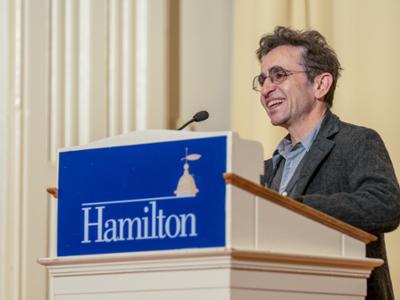
This year’s Tolles lecturer, M. Gessen is a Pulitzer Prize-winning journalist and opinion columnist at The New York Times. In 2017, they won the National Book Award in non-fiction. Their writing focuses on Russian politics, authoritarian regimes, LGBT rights, and questions of identity in the 21st century. Over the course of the evening, Gessen spoke with students, outlined the responsibilities of resistance, explored the mechanics of autocracy, and argued that the tensions of contemporary politics are not just between left and right, but between movements that retreat to an imaginary past and movements that imagine a better future.
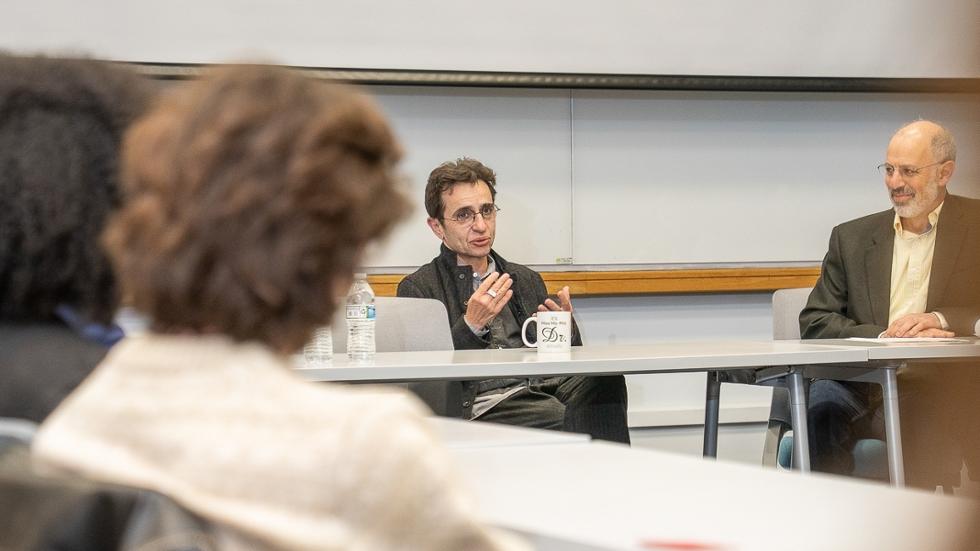
Earlier in the evening, Gessen engaged with students at a roundtable discussion hosted by the Literature and Creative Writing Department. The discussion meandered from MAGA and Putin’s Russia to the writing process and the virtues of a Hamilton education.
“The liberal arts is especially important in the age of AI,” said Gessen, whose own background in science, history, and politics radiates the qualities of an open curriculum. “There’s very little we can automate about the process of writing and thinking.”
After meeting with students, M. Gessen began their lecture with anecdotes from New York City, where they first encountered Zohran Mamdani’s campaign and glimpsed the secret of those who resist autocracy. Gessen described how Mamdani’s campaign grew into a grassroots machine, guided by direct engagement with voters, earnest recognition of shared anxieties, and deep, collective love for The Big Apple. In NYC, Gessen observed, Mamdani invited voters to join him in imagining a better future.
“The liberal arts is especially important in the age of AI ... There’s very little we can automate about the process of writing and thinking.”
Then, Gessen recalled reporting in Hungary, where similar grassroots strategies unseated Viktor Orban, whom many considered Europe’s most entrenched autocrat. Despite Orban’s state capture, government insider-turned-dissident Peter Magyar mounted a revolutionary campaign. Gessen outlined how, by distancing himself from status quo opposition, knocking on doors across the country, leveraging a guerrilla network of print news to bypass state media, and welcoming a big tent of supporters, Magyar swept Orban in a landslide.
Gessen emphasized Mamdani and Magyar’s authentic, grassroots, empathetic, and solution-oriented campaigns as offering the secret to overcoming autocrats.
“But,” he asked, “what is the secret of autocrats? The secret that autocrats have is the politics of the past. They hear people’s anxieties, and they say ‘I’m going to solve that by taking you to an imaginary past.’”
Autocrats promise nostalgic stability while producing deeper instability. Gessen described how autocrats maintain an atmosphere of anxiety and insecurity, then position themselves as all that stands in the way of further degradation.
“But, Zohran Mamdani, Peter Magyar, and so many who won their elections last Tuesday,” Gessen said, reiterating the secrets to a politics of the future, “they rejected that worldview altogether.”
Gessen wrapped up with a handful of midterm success stories. In Texas, messages of neighborly love flipped seats. In Kansas, a candidate who celebrated targeted, anti-trans policies lost while a trans candidate, who ran a grassroots, empathetic campaign, won.
From Hungary to NYC to countless instances across America, those who imagine a positive future win. According to Gessen, a politics of the future says, “I see you. I see your pain. I hear your fears. It can be different.” It says, “we can build a better world together. Let’s start now.”
The Tolles Lecture is an annual series sponsored by the Winton J. Tolles Lecture Fund, established in 1991 by members of Hamilton’s Class of 1951 in memory of Winton Tolles, Class of 1928 and dean of the College from 1947 to 1972. The fund enables the College to bring to campus distinguished speakers in the fields of literature, journalism, and theater to lecture and meet with students.
Posted November 12, 2026