Red Weather Marks a Half Century
Hamilton’s literary magazine Red Weather turns 50 in the fall of 2026. Over the decades, the magazine has been modified but still retains the original vision of its founder, Kirkland College alumna Jo Pitkin K’78. To mark this milestone, she gives us a look back.

Lit Mags Make Landfall
For nearly 200 years, student-produced literary magazines have existed on the Hill. In 1832, Hamilton students brought out the first issue of The Talisman. This publication was succeeded by Hamilton Literary Monthly (later Hamilton Literary Magazine), which was published from 1866 to 1933. In 1941, a new student-run literary magazine, The Continental, came into being. The mission of these various campus literary publications was to showcase student — and sometimes faculty — writing.
Winds of Change Sweep In
In 1975 and 1976, Dessert at the Plaza was Hamilton’s College-funded, student-run literary magazine. I was a member of the staff and also a contributor. After outgoing Dessert editor Robert Weisser ’76 encouraged me to run for the position of editor, I applied to the Publications (now Student Media) Board and was elected in spring 1976 during my sophomore year. A new era was born.
As a dual creative writing and literature major at Kirkland, I took many workshops in our pioneering creative writing program. In one poetry workshop, I was given an assignment to “adopt” a particular literary magazine in order to become familiar with its editorial style, submission guidelines, contributors, and so on. I spent hours in Burke Library not only following one magazine but also studying others in the large collection of literary periodicals housed there. Undoubtedly, this was the spark that inspired me to think about what I could do with our existing magazine’s organization, format, and content.
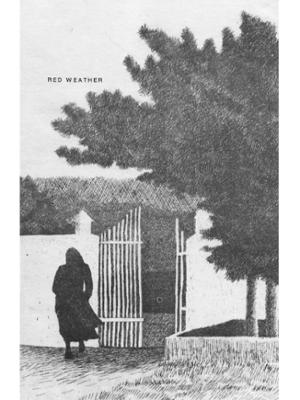 First, I made the radical change of renaming Dessert. I polled my Kirkland creative writing professors and my editorial staff for ideas. After gathering a list of potential names, we voted on Professor Michael Burkard’s suggestion, Red Weather, from Wallace Stevens’s poem “Disillusionment of Ten O’Clock.” To me, this new name better suited the atmosphere of Clinton and the Mohawk Valley. The first issue of Red Weather (RW) came out in the fall of 1976.
After adopting a new name, I made other significant alterations. For example, I felt Dessert’s hefty 8 ½ x 11 trim size was too large, so I reduced RW to a pocket-sized 5 ½ x 8 ½. Eventually, I also created separate staffs for poetry and fiction, as well as production and art. To increase and diversify our pool of contributors, I instituted the use of blind, or anonymous, submissions. I was the only one who knew the identity of those who submitted work to me via inter-campus mail. To advertise upcoming deadlines, I put notices in The Spectator and placed handmade, printed posters around campus.
Just as we did with Dessert, the RW staff met to discuss and select individual pieces for an issue, without the oversight of a faculty advisor. My recollection is that our meeting took place in a classroom near McEwen. Using our best judgments to reach consensus about which pieces to accept, an issue started to take shape. We did not aim to create themed issues but did attempt to find visual and written pieces that complemented one another. How fortunate we were to have a wealth of our classmates’ excellent short stories, poems, photographs, prints, and drawings to choose from!
Shortly after making our final decisions, we dived into production. To the dismay of my dogged production staff, I often inconveniently scheduled production over houseparty weekends (epic parties thrown by fraternities three times a year, typically with live music and free alcohol). In order to physically make our magazine, we had to borrow The Spectator’s office, equipment, and supplies on the third floor of Bristol Campus Center when available. A few of us learned how to operate a large photocomposition machine in a room that reeked of vinegar from the fumes of a film developer. Our text was typed on a special keyboard, printed out on light-sensitive paper, and then cut and pasted by hand onto layout boards using tools such as pica rulers, X-Acto knives, and rubber cement. Like Cinderella rushing to return home by midnight, we scrambled to input, print, correct, lay out, and collate pages in the span of a weekend.
After finished layout pages were put in order, they were handed off to a printer (I believe I used Brodock Press) in Utica. Once RW was printed and delivered to campus, I made sure copies were placed where students gathered, such as Kirkland’s coffeehouse on the first floor of McEwen, Burke Library, Bristol, and dining halls on both sides of the Hill.
In the early years of RW, the magazine was sometimes reviewed in The Spectator. Some reviews were harsh; others were highly complimentary. This was another valuable learning process for those of us who planned to continue to put our writing out into the world after college. Following publication and distribution, the final step was to bring copies of RW to the archives. In my time, the archives were in the musty basement of Burke Library. Doing this last step was required by the Publications Board but, more importantly, also served as a reminder of the legacy of which I had become a part.
Under my editorship, Red Weather was published three times yearly to coincide with our academic calendar of fall and spring semesters plus winter study in January. Since our budget didn’t allow for printing in color, RW’s first six issues all had black-and-white covers. From what I can gather, similar budget constraints have persisted through the tenures of more than a few subsequent editors.
Over the years, I’ve thought about the importance of college literary magazines. Appearing in print, of course, plays a role in developing a young writer’s or artist’s confidence. Additionally, being part of a collaborative staff serves as a training ground for future editing, production, and curating work. As Barbara Berson K’79 commented in an interview in Red Weather’s 45th anniversary issue, “I just loved working on it. I just loved being in the studio and laying it out with people and staying up all night; it was a real labor of love. I just enjoyed it and laughed a lot. I felt like I was in my element.”
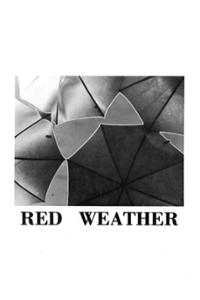
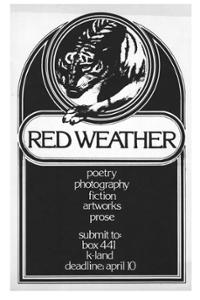
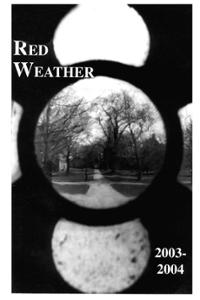
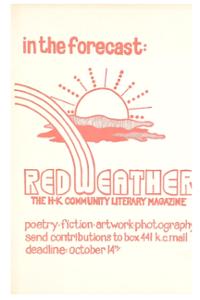
After college, some of us turned our magazine experiences into real-world pursuits — either becoming freelance writers, book or magazine editors, literary agents, or published authors. Many of us have attended graduate school to pursue an MFA in creative writing. Former editors Peter Cameron ’82, Marty Cain ’13, and Kina Viola ’14 even started their own presses (full list of editors at the bottom).
I am proud to have been the first woman editor of a College-sponsored literary magazine on the Hill but, happily, not the last. After Kirkland was absorbed by Hamilton as a result of the tumultuous merger in 1978, I was succeeded by three women editors who had also matriculated at Kirkland — Barbara Berson K’79, Victoria Kohn ’80, and Francesca Richardson ’81 — and a long list of women editors to the present.
Clement Conditions Persist
Since the late 1970s, Red Weather has remained remarkably stable in appearance, organization, and purpose. Yet the magazine has also undergone various alterations. Color covers. Different sizes and shapes. Two issues per year rather than three. Better paper. A book review section. The awarding of literary prizes. The primary editor’s title appears to have morphed from managing editor to editor-in-chief; currently, the magazine has co-editors-in-chief. While there are still separate fiction, poetry, and art staffs, the number of students involved in assorted aspects of creating the magazine has steadily grown. On the other hand, the need for a sizable production staff disappeared with the advent of digital formatting, which streamlined the production process enormously.
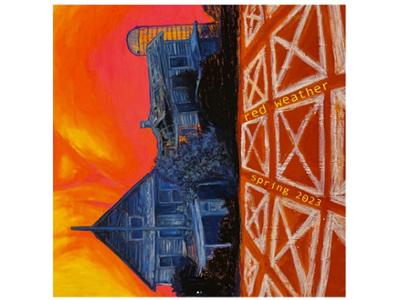
Additional upgrades throughout the decades include RW having its own website and a presence on Facebook, Tumblr, and Instagram. Rather than intercampus mail, today’s editors use email for everything from calls for submissions to receiving contributions. The Hamilton College Print Shop has replaced the use of outside commercial printers. Now, digital issues are available to those on campus or to alumni far and wide: students.hamilton.edu/redweather/backissues and www.redweather.org.
To increase student engagement, RW in recent years has held release parties to celebrate the publication of new issues, hosted open mics, sponsored readings by contributors or guest writers, created tote bags, and organized a live reading of Allen Ginsberg’s “Howl” in Root Glen. I wish I had thought of these innovations.
Clear Skies Ahead
Creating a publication while meeting academic demands isn’t easy. For that reason, I would like to take the occasion of this milestone anniversary to thank the following list of editors, collated for the first time by Jeremy Katz, Hamilton College’s archivist. Whether you used a Compugraphic typesetting machine or a computer, you adhered to a budget, managed a staff, attended Publication or Media Board meetings, garnered submissions, met deadlines, corrected typos, posted flyers, distributed issues on campus, responded to feedback, and archived copies for posterity, you put our own imprint on the issues you produced to create a vibrant venue for student work. Fifty years after founding Red Weather, I am grateful that you, your hardworking staff, and your talented contributors have extended and enhanced my vision of what a campus literary magazine could be. My forecast? More red weather’s approaching.
Red Weather Editors
1970s
Jo Pitkin K’78 1976-78Barbara Berson ’79 1978-79
1980s
Victoria Kohn Michels ’80 1979-80Francesca Richardson ’81 1980-81
Peter Cameron ’82 1981-82
Jenny Krasner ’83 1982-83
Pam Fanning ’85 1984-85
Jean Marie Leverich ’87 1985-86
Katherine Dawson ’88 1986-88
William Thackeray ’91 1988-89
Amy Kline ’92 1989-91
1990s
Dana Silber ’92 1991-92Karin Gosselink ’94 1992-93
Adam Chamberlain ’95 1994-95
No issues in archives 1996-97
Amanda Kogut ’98 & Lisa Horner ’98 Spring 1998
Emily Melhorn ’01 Spring 1999
2000s
Kathryn Adams ’02 Spring 2002Evan Adair ’03 Spring 2003
Thomas Acampora ’05 2003-04
Rachel Manwill ’05 2004-05
Rachael Arnold ’08 Spring 2006
Greg Leiman ’07 Fall 2006
Rachel Richardson ’09 Fall 2007
Katie Naughton ’08 2007-08
Rachel Richardson ’09 2008-09
Danielle Raulli ’10 2009-10
2010s
Olivia Wolfgang-Smith ’11 2010-11Marty Cain ’13 2012-13
Kina Viola ’14 2013-14
Zoë Bodzas ’16 & John Rufo ’16 2014-16
Adam Evertz ’17 & Annie Berman ’18 Fall 2016
Joe Rupprecht ’18 & Annie Berman ’18 Spring 2017 - Spring 2018
Julia Rosenbaum ’19 & Hunter Lewinski ’20 2018-19
Hunter Lewinski ’20 & Rachel Lu ’22 Fall 2019
2020s
Rachel Lu ’22 & Eva Glassman ’23 2020-22Eva Glassman ’23 & Lucy Seward ’24 Fall 2022
Eva Glassman ’23 & Christina Stoll ’25 Spring 2023 - Fall 2023
Lucy Seward ’24 & Sydney Lee ’27 Spring 2024
Christina Stoll ’25 & Sydney Lee ’27 Fall 2024
Dana Blatte ’26 & Sydney Lee ’27 Fall 2025
Dana Blatte ’26 & Helen Gass ’29 Spring 2026
2025-26 Highlights: The Year in Review
Over the past year, Hamilton students, faculty, staff, and alumni came together to think about the future, tackle challenges, and celebrate each other. From a historic NCAA title to research, creative work, and partnerships that reached across the Mohawk Valley and around the world, these stories capture some of the moments that defined the 2025-26 academic year.

Writing is hard; writing well is even harder. And like most skills, it takes practice to get better. Students at Hamilton have been perfecting their writing skills outside of the classroom as far back as the early 1830s with the debut of a literary magazine known as The Talisman.
