Connor Havelka ’28
Majors: Classics and Literature & Creative Writing
Hometown: Holland Pa.
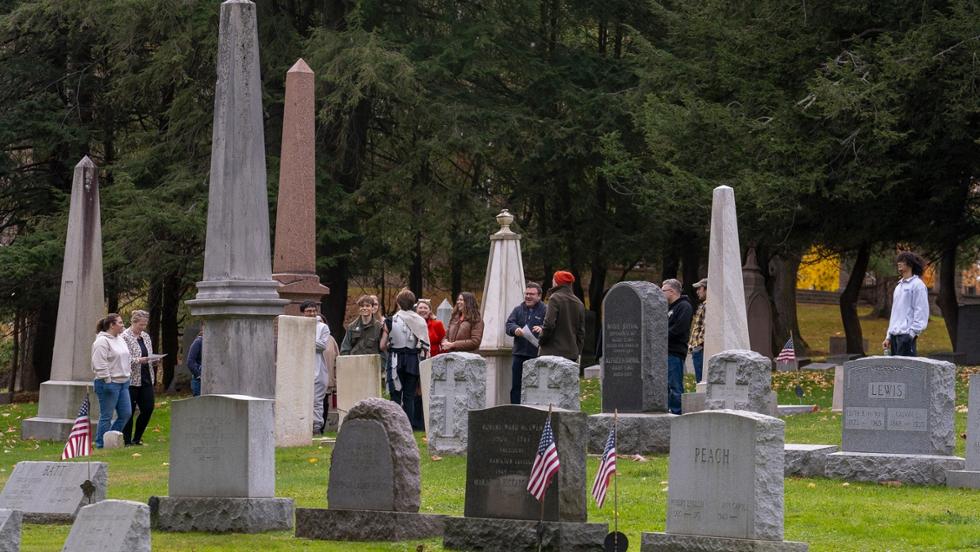
While this event focused on spooky tales of individuals resting on the site, the research that led up to the tour highlights opportunities for students to pursue their academic interests. Havelka spent the summer as a Curatorial Studies intern finishing an ArcGIS story map of the cemetery that built on earlier design work done by Ella Strasser ’26. As Havelka compiled biographies and analyzed causes of death, he began to feel connected to the people who shaped Hamilton and wanted to share that with the community.
Hamilton Communications Office student writer Mairin Hoffman ’29 recently connected with Havelka to discuss the research process and the story behind his passion.
Q
How did you get involved with the Curatorial Studies initiative, and how did you end up on this project?
My “day job” is at the Burke Circulation desk, and as part of training we were given a tour of the Hamilton Archives, and I got hooked! The mix of the history and the stewardship that fascinated me. I’ve always loved history, so getting to work with genuine artifacts was a massive draw. But what really took me in was the duty that comes with the field. You have a responsibility to not only preserve history, but to present that history to the world. So, I took Jeremy Katz’s course on Archival Practices shortly after, where I learned about a potential opportunity to work in the Hamilton College Archives. I applied to the position last December, and they chose me!
Q
Where did the biographical information come from? What was hardest to track down?
There were two categories, really. People directly associated with the College were easy to research. Thanks to our digital collection of Hamilton’s magazine, we have almost 200 years of biographies, memorials, and necrologies. Even the students were relatively easy to track down in the magazines, even if their biographies were a little thinner. Those not directly [associated with Hamilton] were far more difficult — sons, daughters, wives, etc. I often had to resort to newspaper archives or websites like Ancestry. No one specific stands out, it was a chronic problem.
Q
Was there a person whose story surprised you or stuck with you?
That’s a tough question. There are former librarians, famous professors, the namesakes of dozens and dozens of buildings. I think the story that stuck with me the most is the 1884 class stone. It’s a glorious story of student rebellion, intrigue, and drama.
Briefly — in February 1884, former President North passed away on a Saturday. Tradition at the time dictated that students would have off between the announcement of the death and the day of the funeral. As his funeral was scheduled for a Tuesday, students expected to have both days off. However — supposedly, at the wishes of North’s family, including beloved faculty member “Old Greek” North — President Darling announced that classes would go forward as usual on Monday.
The students, naturally, skipped classes on Monday and assumed the affair put to bed … not so. Darling, considering the mass-skipping an act of student rebellion, indefinitely suspended multiple leading members of the senior class, accusing them of conspiracy. Naturally, all hell broke loose. The senior class promptly “bolted,” leaving campus en masse.
What followed was a campaign of insults on both sides — Darling threatening to expel any student who didn’t give him a hand-signed apology letter, students getting their accounts of the affair published in The New York Times.
The whole thing ended when Old North’s job was put on the line — effectively, either the students would return, or their beloved faculty member would take the fall and resign. They chose the former, but got the last laugh in the end. Not only did the suspended students return, but they added a small detail to their class stone: a bolt, resting atop a tree trunk.
Q
What do you hope people take away about Hamilton’s history from the cemetery?
Hamilton’s history isn’t all stuffy classrooms and rich kids, and we should celebrate and revel in that. We had international students in the 1860s, theatrics and theatre kids, petty rivalries and feuds that transcend the afterlife. We had a man’s bones in the floorboards of one of our dorms for 80 years (Samuel Eels). I suppose the other thing I want to do is just draw attention to the cemetery. It was founded as a place to celebrate life, a park to picnic in just as much as a final resting place.
Q
Is there anything I didn’t ask that you think people should know?
Even in the graveyard, there are plenty of little injustices. Three individuals without headstones. Multiple individuals without birth or death years. Headstones crumbling. A former president’s grave stuck in the mud. Wives and daughters simply absent from the record. My hope is that, with the website up and running, more people will explore the graveyard, learn about the college’s history, etc. And, if all goes well, some of these little injustices will be undone.
Posted November 9, 2026
