When the Frogs Start Calling, the Research Begins
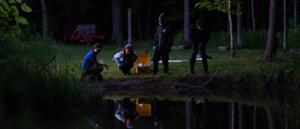
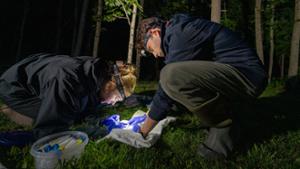
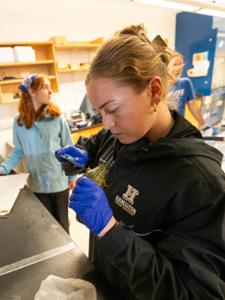
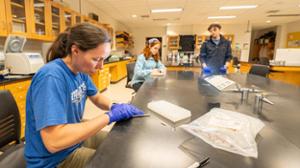
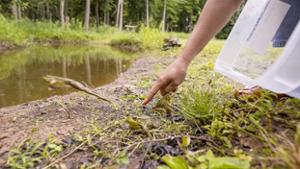
This summer, Assistant Professor of Biology Ariel Kahrl and four students, Austin Tubia ’27, Alden Duserick ’27, Andrea Hernandez Ramirez ’27, and Madison Kob ’28, are investigating amphibian fertility by studying male green frogs and their environments. Several nights a week at around 9 p.m., the team heads to ponds on and around campus to collect water samples and catch green frogs to bring back to the lab where they undergo testing the following day.
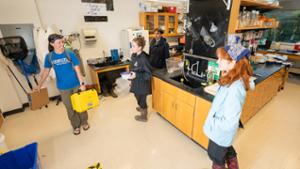
“Green frogs are much easier to catch than I thought they’d be,” Tubia said. “The male frogs call a lot during their breeding season over the summer, and because they’re cold-blooded, they’re not quite as fast when it’s colder at night. It’s a lot of fun, and it’s quite safe.”
The students are working on two complementary projects. Tubia, Duserick, and Kob examine how pollutants commonly found in waterways affect the reproductive health of green frogs, while Hernandez Ramirez studies the flagellar motion of amphibian sperm to better understand fertilization and evolution.
“Our lab is interested in how environmental contaminants, like herbicides, pesticides, fertilizers, and fungicides can affect reproduction in aquatic organisms,” Kahrl said. “In the frogs we are measuring stress hormones and reproductive hormones, their metabolism, how colorful the males are [they have bright yellow bellies that are influenced by testosterone], as well as taking a sperm sample to look at their fertility.”
The work combines field biology, physiology, chemistry, and ecology. Water collected from each pond is analyzed alongside measurements from the frogs, allowing the team to identify relationships between environmental contaminants and reproductive health.
For Tubia, the project was an opportunity to build on concepts he first encountered in the classroom.
“I ended up being fascinated when learning about all animals’ underlying biological processes, and this project offered a unique physiological perspective on neuroscience,” he said. “We are also analyzing water quality from each pond … which interested me because it helps me get a more tangible understanding of how human interactions with the environment can have substantial ecological impacts.”
Duserick was drawn to the project for similar reasons but from a broader environmental perspective.
“I really wanted to research something that has the potential to have large-scale impacts outside of just this specific project,” she said. “Our findings have the potential to provide valuable evidence regarding previously unknown impacts on certain environmental contaminants.”
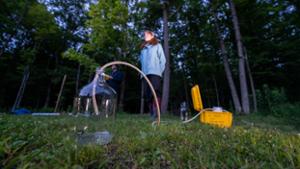
Each afternoon, the frogs move through a carefully choreographed series of tests before later being returned to the ponds from which they were caught. Primarily, Duserick and Tubia focus on neuroscience research and hormone analysis. Kob focuses on filtering and extracting contaminants from the water samples they collect to identify the specific toxins present.
“I really wanted to research something that has the potential to have large-scale impacts outside of just this specific project.”
As an environmental studies major, the public health and conservation elements are what initially made Kob passionate about this project. However, as she worked, she began to feel curious about other aspects as well.
“Honestly all of the smaller facts I’ve picked up over the course of the month have stood out to me the most,” she said. “I really enjoyed that sense of new curiosity and enthusiasm, and I continue to be impressed by the wealth of knowledge Professor Kahrl has about amphibians, which is only surpassed by her love for them.”
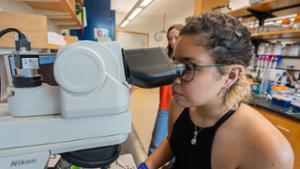
While Duserick, Tubia, and Kob focus on environmental contaminants and hormonal effects on these frogs, Hernandez Ramirez’s project asks a different question: How do amphibian sperm move?
“As an interdisciplinary major, biophysics, I really wanted my project to be both biology and physics,” she said. “Professor Kahrl looks at the entire fertilization of amphibians from many perspectives. She wants to create a big and full picture.”
“Through this lab I also realized how much I love to talk about science and getting others as excited as it makes me, and found I am going to go into science journalism.”
Returning for a second summer has also allowed Hernandez Ramirez to share her experience with newer members of the lab while continuing her own research.
“I have learned more techniques, skills, and confidence,” she said. “Through this lab I also realized how much I love to talk about science and getting others as excited as it makes me, and found I am going to go into science journalism.”
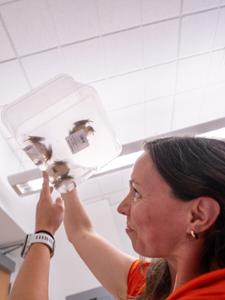
For Kahrl, seeing students take ownership of the research has been one of the most rewarding parts of the summer.
“The students have had a huge hand in every aspect of the project,” she said. “Because we have so many different techniques, each student has been able to be a specialist in a different part of the project, giving them real ownership of the science.
“Because we have so many different techniques, each student has been able to be a specialist in a different part of the project, giving them real ownership of the science.”
“What has made me most excited this summer is the enthusiasm my team has for what we’re doing,” Kahrl added. “They also see the real-world importance of our findings to help influence policy around the use of chemicals, which can really keep you motivated when you are working on a long-term project.”
While the data will be analyzed in the coming months, the team hopes the research will contribute to a better understanding of how environmental contaminants affect aquatic wildlife and provide evidence that may one day help guide decisions about chemical use.
Student Research at Hamilton

Kudos! 2025-26 Student Achievements
As the 2025-26 academic year wrapped up, students were honored with scholarships and awards, and presented research at professional conferences.
Senior Fellow Afsar-Keshmiri ’26 Dives Deep into Neurodegenerative Diseases
As a senior fellow, Julia Afsar-Keshmiri ’26 has amassed a network of scientists to further unravel the mysteries of brain development and neurodegenerative diseases. Through her fellowship, Afsar-Keshmiri has the opportunity to devote her entire senior year to her project, giving her a taste of life as a professional researcher.
