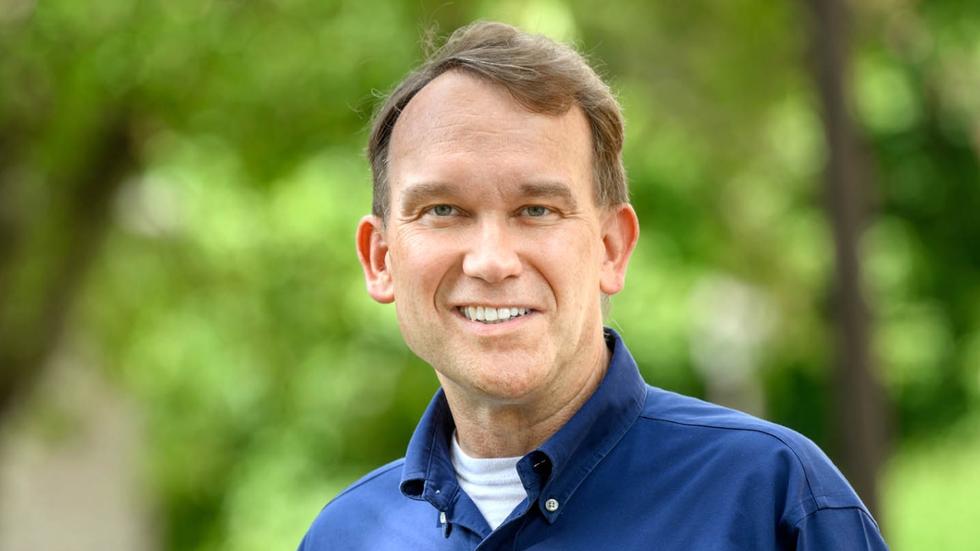
In the Q&A below, student writer Dehler Ingham ’27 asked Linsin to reflect on what brought him to College Hill, how small liberal arts colleges can foster personalized care, and his vision for making student health and well-being a shared campus commitment.
Q
Dr. Linsin, thanks for sitting down with me, and welcome to the Hamilton community. To start off, I want to ask you a question that students are familiar with. What is your “Why Hamilton?”
Great question! My “Why Hamilton” is that the more I learned about Hamilton, the more excited I became about the College. During the application and interview process, I heard the term “Hamily” for the first time. My experiences since have reinforced that the Hamily is a close-knit community working together to make this the best educational institution and to provide the best student experience.
Also, the prospect of working at a small liberal arts college with a strong sense of its history was appealing. My undergraduate institution was the College of William & Mary, which has a similar feel to Hamilton. It’s a strong liberal arts institution with a great respect for its history. And, like Hamilton, it doesn’t rest on that history — both are willing to explore innovations and keep everything fresh and relevant.
Q
That makes total sense — and builds into my next question. Your previous professional experiences have been at larger research universities. What excites you about working with a small student body and in a deep liberal arts infrastructure?
A few things. For one, at a small institution there are more opportunities for personalized care and support, which is especially important when any mental health concerns are first starting to emerge. That was a key part of my interest in coming here: seeing that there were so many resources available for students beyond just the counseling center.
I like the opportunity for this kind of early awareness, and I believe that in most situations, the earlier one can recognize that there are challenges, the better chance [there is] to get through those situations before things get worse. I’m glad that the counseling center can be a part of that, both early in the process and, at times, later in the process. I think counseling centers have a role to play in promoting balance, empowering life choices for students, and contributing to as many positive college experiences as possible.
Q
Speaking of college experiences, what do you think students today are experiencing differently when it comes to mental health?
I think college students nowadays, including Hamilton students, are facing challenges that my generation didn’t have to face as a college student. The competition for jobs is more difficult nowadays. Back when I was an undergrad, there was this kind of widespread societal belief that once you got your college degree, that really set you up for a lot of things. I think in recent years, there’s a shift where students are graduating with their bachelor’s degrees and finding not as many opportunities available.
One thing I want to emphasize is that the counseling center is available for students who want to talk confidentially regardless of what they might happen to believe about the severity of what they’re dealing with. I think sometimes a barrier for seeking help is a sense of “well, yeah, I’m struggling with this, but, you know, is that really the kind of thing that warrants going to see a counselor?” I definitely don’t want that to be a barrier for students. We all go through challenges from time to time, and I think counseling can be a place where folks can get some normalization about those concerns.
Q
For sure, and a huge part of that is a campus culture that normalizes those feelings. However, while there are 24/7 resources available, counseling center staff can’t be everywhere all at once. What role do faculty, coaches, staff, and student leaders play in supporting student well-being?
Yeah, good question. I’ve worked for about 20 years at colleges and universities. One of the things I always emphasize is that as a counselor at a college counseling center, if a student is having challenges, I hope to find out about it eventually. But statistically speaking, somebody in my role is pretty far down a student’s network. I think that faculty, fellow students, CAs, and coaches are all important resources for directing students toward additional help. Compared to somebody like me, those people are closer to the front lines when it comes to awareness of struggles.
Q
That makes complete sense. As you begin your first year at Hamilton, what are you looking forward to?
I’ve been here since July 6, and I’ve already enjoyed connecting with campus partners, connecting with students, connecting with other staff and faculty. It really has reinforced the sense of Hamilton being a very friendly place where people are eager to learn and eager to collaborate. So I’m looking forward to making more connections with students, faculty, and staff. I’m also looking forward to learning how else the counseling center can be a part of the campus conversation around wellness and the human experience. My background in college counseling centers is as an outreach coordinator, and I still have an interest in the power of educational and awareness programs to facilitate healthy conversations about relevant and challenging topics.
Q
Is there anything else you’d like students to know about you and the counseling center?
One thing about myself and the counseling center is that everybody here is very excited to be at Hamilton. We all believe very strongly in the values that guide how Hamilton takes on learning and wellness. We’re all here because we want to be here. Generally speaking, for those of us in the counseling field who work at colleges, it’s a real destination job because we value the opportunity to work with college students and the opportunity to be a part of a college setting.
It’s not just a job. It’s the kind of work that we believe in deeply and feel very passionate about. What I would say to Hamilton students is that if you come to the office, we’ll be happy for the opportunity to work with you, and we’ll do our very best to give you the best counseling experience possible.
Posted September 10, 2026