A biology major with minors in geosciences and environmental studies, Papetti traces her interest in plant science to Assistant Professor of Biology Pete Guiden’s introductory biology course Secret Life of Plants. Through the class and its herbarium project, she discovered a new way of looking at the natural world.
“[It] allowed me to see plants in a way I hadn’t before,” she said. “While many biology classes have you look at animals as separate life forms and organisms, this class reminded me to look at plants the same way. It intrigued me because every plant is beautiful and different.”
Papetti knew she wanted to pursue plant biology more seriously. She joined Guiden’s plant-animal lab as an independent researcher, where she began studying tree masting behavior and seed dispersal.
“Working with plants every day — and constantly getting to learn new things about how they function and their evolution — is what I want to do.”
That passion took her to the Arnold Arboretum of Harvard University where she spent the summer conducting research under Arboretum Director and Professor of Organismic and Evolutionary Biology Ned Friedman. Her project focused on the roots of plants in the Boraginaceae family, examining changes in plant form across species and genus levels.
That experience confirmed that plant research was what she wanted to pursue.
“I never wanted the internship to come to an end,” she said.
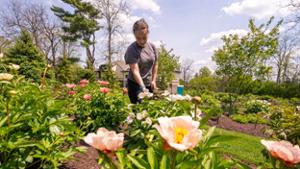
Before returning to campus last fall, Papetti reached out to Hamilton’s Arboretum staff in hopes of continuing her work with plants. She was hired by Facilities Management and has since contributed to several projects in the Root Glen, including creating a Google Maps walking tour and designing “Tree of the Month” educational posters to display in the Glen. Among her favorite projects have been caring for the Saunders peonies and identifying species in the alpine plant bed.
Papetti continued her plant science research this summer at Cornell University as part of the Programmable Plant Systems Research Experiences for Undergraduates program. She focused on examining how carbon moves through maize plants and how plants respond physiologically to environmental stresses such as drought. By tracking carbon allocation above and below ground, she worked to better understand how plants function under changing conditions.
Looking ahead, Papetti hopes to build a career as a plant biology researcher.
“Working with plants every day — and constantly getting to learn new things about how they function and their evolution — is what I want to do,” she said.
Posted October 5, 2026