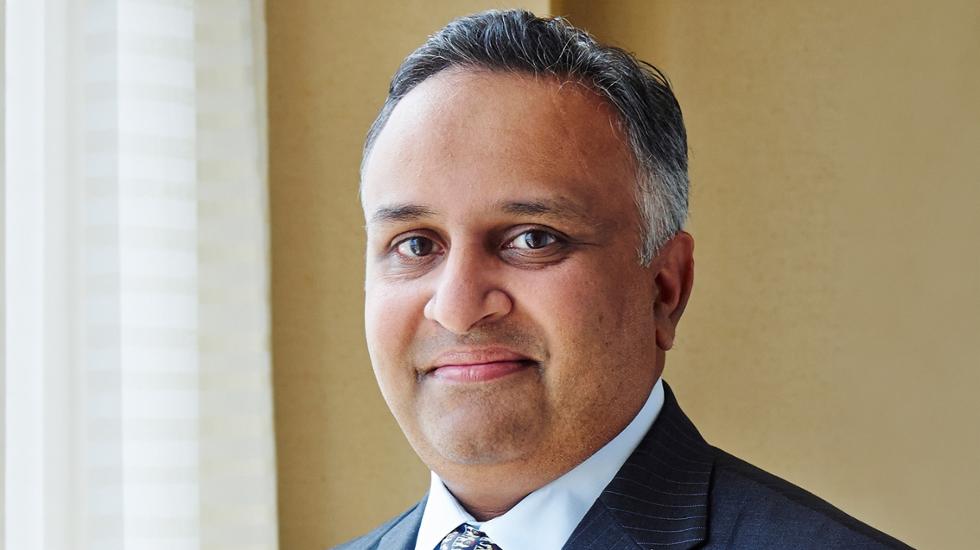
In two decades at Bank of America, he led teams that launched mobile apps; directed the creation of peer-to-peer payment system Zelle; instituted the revolutionary AI financial assistant Erica; and oversaw a portfolio of 4,500 patents, ultimately serving as chief technology and information officer. During his tenure, the firm earned numerous accolades, including making Fortune’s list of “America’s Most Innovative Companies.”
This past year, Bhasin embarked on a new venture as a partner at Falfurrias Management Partners — a $3.8 billion private equity firm in Charlotte, N.C. — working with middle market companies on their technology and growth strategies. A chemistry and computer science major at Hamilton, he served on the College’s Board of Trustees and is now vice chair of Discovery Place, a children’s science and technology museum in Charlotte.
Q
When you arrived at Hamilton, you came as a pre-med chemistry major, but switched to computer science after taking an intro class — why?
It was really about the structure of the curriculum at Hamilton, which didn’t let you take all your science credits in one discipline. I thought maybe I should do something different, and computers seemed to be important (laughs). Once in computer science, I was drawn to the problem solving and structured thinking it required, and the fact that there was no ambiguity in the outcome. If you wrote a program to do a certain thing, the outcome was assured. But it also allowed for creative problem solving, because there wasn’t only one way to create an outcome.
Q
What’s something you’ve learned about the realm where business and technology intersect that might surprise people?
The most important learning for me is that it’s not about the technology at all. Too many projects begin with “Hey, here’s a cool new technology, how should we use it?” and that almost always yields a bad set of outcomes. It’s more important to start by asking what are the business problems you are trying to solve and what are the processes involved in that — and then asking how technology can enable or accelerate or eliminate those processes.
Q
You oversaw a portfolio of 4,500 patents at Bank of America. Were there any that you were excited about that didn’t see the light of day?
The biggest thing we were trying to drive in the patent program wasn’t necessarily how many of them turned into actual products. It was to get everybody in the team engaged in a culture of innovation. Too often big companies will create an innovation lab and say, that’s the cool place where these 20 “innovators” are — we rejected that notion completely. Our technology team had 60,000 people in it, and I wanted everyone to be able to get out of their job for a minute, think about an innovative idea, and write it down. That made everyone better at their jobs.
“ ... I wanted everyone to be able to get out of their job for a minute, think about an innovative idea, and write it down. That made everyone better at their jobs.”
Q
The breakthrough virtual financial assistant Erica was recognized as a model in chatbot technology. What did it teach you about what customers really wanted?
It goes back to being relentlessly focused on the customer and asking the right questions. Erica was started as a result of asking how we can help customers use the thousands of features in a mobile app better. If you want to order foreign currency, you can’t have that on the homepage because it’s used infrequently. So we said what if there is a textbox where you could just say what you wanted, and the interface would point you to it. It turns out one of the top things customers still ask for is “What is my routing number?” and now they can easily find the answer to that question.
Q
You’ve said that artificial intelligence isn’t really a new technology but a new chapter of a familiar technology. How does that influence how you advise companies to use it?
In financial services, we’ve been analyzing spending patterns and debt payments to predict future payment ability for a long time. You might say, “That’s really innovative use of AI,” but it’s called a credit score and we’ve been doing it for 40 years. The basics remain the same — focus on your customers, know the business problem you are trying to solve, and look at your processes and figure out where AI can be most beneficial. What can be fully automated, what can be partially automated, and what controls you need to put in at each step to make sure it didn’t make a mistake.
Posted October 15, 2026