
Open Curriculum
Hamilton College is one of the few U.S. colleges with an open curriculum, which means you design your education from the first semester. You can choose classes that intrigue you and have time to change direction without falling behind.
How our open curriculum works
Instead of starting college off with a checklist of academic requirements, we want you to start with questions: What are you curious about? What excites you? What do you want to understand better?
Over the course of your four years, you’ll build the timeless skills that matter most — how to think clearly, communicate effectively, and understand complex issues — through courses that strengthen your wiring and presentation skills, challenge you to think about the world from a different perspective, and build your confidence working with data, theories, and ideas.
Frequently Asked Questions
For the most part, yes, but Hamilton’s professors believe so strongly in the importance of writing that they will require you to enroll in three writing-intensive courses. In these courses, which are offered throughout the curriculum, you will often write drafts, receive feedback on composition, form, and content, and pursue substantive revisions. We also expect you will demonstrate facility in quantitative and symbolic reasoning by completing one or more courses in at least one of the following three categories: statistical analysis, mathematical representation, and logic and symbolic reasoning. Finally, Hamilton maintains a physical education requirement.
Although our curriculum has relatively few requirements, our professors have many expectations that reinforce the educational values of the College.
To graduate from Hamilton you must complete 32 units (almost all Hamilton courses are one unit). This includes three writing-intensive courses, at least one quantitative and symbolic reasoning course, the physical education requirement, and the requirements for your concentration (what most colleges call the major), including a course that addresses how social categories structure the world in which we live.
Many students do not start their Hamilton education with a clear idea of which major or concentration to pursue, and many others change their proposed concentration during their first two years. Some choose more than one concentration or combine a concentration with a minor. You will declare your concentration in the spring of your sophomore year. Each concentration includes a Senior Project.
Why choose the Open Curriculum? Learn from students and faculty about why they love Hamilton’s curriculum.
Advising
Working closely with a faculty advisor, you’ll create an individualized plan of study that reflects your interests and graduate as a critical and creative thinker, writer, and speaker — skills that will help you stand out in the job market or when applying to graduate school.

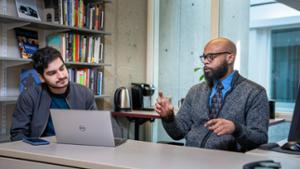

“This semester I’m taking Computer Science 101. Nearly everyone is from a different discipline, so every single one of us brings a different perspective. As a history major, I come from a more writing- and reading-intensive critical thinking framework, whereas others come with a more quantitative mindset. It’s really special to see people coming up with these different ideas of how to approach problems.”

Areas of Study
Hamilton offers 44 majors (we call them concentrations) and 58 total areas of study.
- Africana Studies
- American Indian and Indigenous Studies
- American Studies
- Anthropology
- Arabic**
- Archaeology
- Art
- Art History
- Asian Studies (China, India, Japan)
- Astronomy*
- Biochemistry/Molecular Biology
- Biology
- Chemical Physics
- Chemistry
- Chinese
- Cinema and Media Studies
- Classics
- Computer Science
- Creative Writing
- Dance and Movement Studies
- Data Science
- Digital Arts*
- East Asian Languages and Literatures
- Economics
- Education Studies*
- English
- Environmental Studies
- French and Francophone Studies
- Geoarchaeology
- Geosciences
- German, Russian, Italian, Arabic
- German Studies
- Government
- Greek: See Classics
- Hebrew**
- Hispanic Studies
- History
- Interdisciplinary Concentration
- Italian Studies*
- Japanese
- Jewish Studies*
- Jurisprudence, Law and Justice Studies*
- Latin: see Classics
- Latin American and Latine Studies*
- Literature and Creative Writing
- Mathematics and Statistics
- Medieval and Renaissance Studies*
- Middle East and Islamicate Worlds Studies
- Music
- Neuroscience
- Philosophy
- Physics
- Psychology
- Public Policy
- Religious Studies
- Russian Studies
- Sociology
- Spanish
- Statistics*
- Theatre
- Women's and Gender Studies
- World Politics
